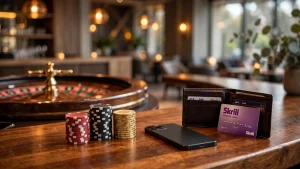
Acceptance varies between operators, so payment options, deposit conditions and withdrawal eligibility need to be checked separately.

Amex appears in discussions of payment options at some Australian-facing online casinos, but it is not a payment method that every site accepts. A specialist review reports that Amex deposits are available at some casinos; another specialist review notes that some online casinos do not accept the card. The practical picture is therefore mixed: seeing Amex mentioned in a general description of casino payments does not mean it is available everywhere.
That distinction matters because “accepts Amex” can sound like a settled, market-wide feature. It is not. Payment options vary between operators, and the card’s presence at one site says nothing reliable about its presence at another. For you, Amex is a possible payment route, not a default one.
When a casino says it supports Amex, that statement refers to its own payment arrangements. It is not a claim that Amex will be accepted by every casino serving Australian users, or that the card is a standard option across the market. A casino may present a set of payment methods that differs from another casino’s set.
If you’re looking for an Australian casino site that accepts Amex, check the payment options directly before depositing: the details available here do not confirm Amex acceptance. These notes give you the available licensing and minimum-deposit information to help frame your checks.
Uptown Pokies
Uptown Pokies has operated since 2017 under a Curacao license, with a stated minimum deposit of A$20. The available details do not confirm whether you can deposit with Amex.
Vegaz Casino
Vegaz Casino lists Curacao license OGL/2024/1335/0780 and a minimum deposit of EUR 20. You’ll need to check with the casino whether Amex is accepted.
Roby Casino
Roby Casino is listed as licensed by Curacao eGaming, with Roby Games Ltd named. No deposit minimum or payment-method details are provided, so you’ll need to verify Amex acceptance directly.
Lucky Dreams
Lucky Dreams lists a Curacao license and an A$20 minimum deposit via POLi. The available details don’t establish whether Amex is also an option.
Thor Casino
Thor Casino lists a Curacao license issued by Antillephone N.V., with Versus Odds B.V. named, and a minimum deposit of EUR 20. Check directly whether Amex is available for your deposit.
LevelUp Casino
LevelUp Casino lists Curacao eGaming license OGL/2023/174/0082, held by Dama N.V., and a minimum deposit of A$15. Amex acceptance isn’t specified in the available details.
SpinsUp
SpinsUp is listed under Curacao Gaming Control Board license OGL/2023/174/0082, held by Dama N.V. No deposit or payment-method information is provided, so confirm Amex availability directly.
DragonSlots Casino
DragonSlots Casino is listed as licensed by the Curacao Gaming Authority, with Jumpman Gaming Ltd named. The available information doesn’t specify deposit options or Amex acceptance.
Rollero Casino
Rollero Casino lists Curacao Gaming Control Board license OGL/2023/176/0095, held by Hollycorn N.V. No payment details are provided, so check with the casino about Amex.
GoldenCrown
GoldenCrown lists Curacao Gaming Control Board license OGL/2023/176/0095, held by Hollycorn N.V. The available details don’t say whether you can use Amex or what the deposit minimum is.
This is why broad labels such as “Australian casino that accepts Amex” need to be read carefully. They describe a particular operator’s stated payment setup, not a shared feature of Australian online casinos. Even within general information about Australian-facing sites, acceptance should not be assumed to carry over from one service to another.
A useful way to frame the choice is by criterion. If your criterion is simply whether Amex is listed as a deposit option, the relevant question is site-specific. One card, different rules.
Casinos make their own decisions about which payment methods to offer. As a result, Amex may appear alongside other methods at one site and be absent from another. A shared audience or similar service description does not establish that two operators use the same payment options.
That variation also makes older descriptions less useful as a guarantee of present availability. Payment menus can change, so a statement about Amex at a particular casino should be understood as applying to the service and point in time it describes. It is not a lasting assurance that the same option will remain available.
The same caution applies to broad claims about “Amex pokies” or mobile casino payments. Those phrases can suggest a distinct category, but the central issue is still the payment option offered by an individual casino. The device or game label does not establish card acceptance. A mobile site and a desktop site may present information differently, but the fact that a casino is accessible on a phone does not, by itself, tell you whether Amex is accepted.
Amex has a limited, conditional place in this payment landscape: some casino payment descriptions include it, while others do not. That makes it relevant to people who specifically want to use the card, but it does not make it a universal option. Nor does the word “accepted” mean every player will encounter the same payment choices.
Keep the comparison simple. Amex is a possible option at some Australian-facing online casinos; it is unavailable at others. The operator’s own payment information is more relevant than a general claim about Australian casinos as a whole. No market-wide rule follows from one casino’s menu.
Amex acceptance alone says nothing about the broader terms or status of a site. For the payment question itself, the criterion is straightforward: is Amex actually offered by that individual operator? If not, a general reference to Amex elsewhere does not change the answer.
A casino cashier may show Amex as a payment option, but the amount you can enter and any charge attached to the transaction are determined by the operator’s rules. Specialist payment reviews report that Amex deposit limits differ between casinos and may change, so a limit described for one site should not be treated as a general rule. The cashier’s own terms are the relevant place to check the amount available for a particular account.
Deposit Process
Select Method
Choose Amex as your payment method in the casino cashier.
Enter Details
Provide your card details and the deposit amount in Australian dollars.
Submit Payment
Submit the payment, ensuring the amount falls within the casino's permitted deposit range.
Where a cashier offers Amex, the stated transaction sequence is straightforward: select Amex as the method, provide the card details, enter the deposit amount in Australian dollars, then submit the payment. The currency matters because the amount shown in the cashier is in AUD; the card issuer’s handling of a transaction can be a separate consideration, rather than part of the casino’s displayed deposit limit.
That sequence describes how the payment option is presented, not a guarantee that a transaction will be accepted. The amount entered still has to fall within the limits that apply at that casino, and the payment must be processed under the operator’s and card issuer’s rules. A displayed method and a completed transaction are not the same thing.
Before submitting any payment, read the cashier information alongside the casino’s payment terms. Look for the permitted deposit range, any stated fee, and whether the amount shown is the amount that will be charged to the card. If the cashier’s information and the general terms appear inconsistent, the uncertainty is a reason to pause rather than guess. A payment screen is not a substitute for clear terms.
There is no single Amex deposit ceiling that applies across online casinos. Specialist payment reviews describe limits as casino-specific, with operators setting their own minimums and maximums. An amount available at one cashier therefore tells you little about what another cashier will permit. Even within one service, the applicable range may depend on the account or the payment conditions presented at the time.
Treat the displayed limit as a transaction rule, not as a recommended amount. If a requested deposit falls outside the permitted range, the cashier may not accept it. The only dependable figure for a particular transaction is the one the operator presents for that account and method. Avoid relying on an old review or an amount copied from another site: those details can become outdated, and a comparison only works when the terms are current and like-for-like.
A useful way to compare the cost is to separate three things: the amount entered, any fee stated by the casino, and any other charge disclosed by the payment terms. That keeps the question practical. A deposit limit tells you what the cashier allows; it does not tell you whether the transaction carries a cost.
Specialist payment reviews describe Amex deposits as commonly having no casino fee, while also noting that charges depend on the individual operator. That is not a promise that every deposit is free. Check the cashier and the applicable terms for a fee before submitting, and do not assume that a fee statement for one casino carries over to another.
The distinction between a casino fee and a card-related charge is also important. A cashier may state whether the operator adds a charge for the deposit, while the card’s own terms govern the card account. The amount in AUD shown during payment is therefore only one part of understanding the final cost. Read the relevant terms rather than treating “no deposit fee” as a universal description of every cost connected with the transaction.
If the operator’s fee information is unclear, do not infer that the charge is zero. A careful comparison records the stated limit and the stated fee separately, and leaves either field unresolved until the terms make it clear. This avoids a familiar but unhelpful shortcut: choosing by the size of the permitted deposit while overlooking what the transaction costs.
When reviewing a cashier, note whether Amex is offered, what AUD range is displayed, and whether the operator states a deposit charge. The right comparison depends on whether your priority is a particular deposit range or predictable costs.
Keep the distinction between general payment commentary and current cashier terms in view. Reviews can summarise how limits and fees have been described, but the operator’s own payment information is the relevant reference for its current conditions. If the details are absent or unclear, there is no sound basis for assuming a specific limit or cost. Clear terms first.
An Amex withdrawal should not be treated as an instant payout. A specialist review gives a clearance time of up to five days for casino withdrawals to Amex. That is a stated upper timeframe, not a promise that every request will clear within it. The actual wait can depend on the casino’s rules, and the card route may not be available at all.
The distinction matters if you are comparing payment methods by speed. “Instant withdrawal” can describe a casino’s handling of a request, but it does not establish that money will reach an Amex card immediately. The reported clearance time is measured in days, so an instant Amex casino payout is not something you should assume from a general claim about fast withdrawals. Check the wording that applies specifically to Amex and to the withdrawal itself.
The reported period of up to five days gives you a reference point for planning, but it is not a guaranteed deadline. It does not mean that every withdrawal takes the full period, nor that all casinos use the same schedule. A casino’s own cashier information and payment terms are more relevant to a particular request than a general description of Amex payouts.
Look for a clear statement about the expected clearance time, and note whether it refers specifically to Amex withdrawals. If the casino gives no Amex-specific timing, a timeframe for another payment method cannot safely be applied to your card. A quick deposit, where offered, also says nothing about how quickly a withdrawal will clear. Different direction, different clock.
Avoid relying on the word “instant” without knowing what it describes. It may be used broadly in payment information, while the Amex-specific clearance time is stated separately. For a useful comparison, record the payment method, the published withdrawal timeframe and any fee together. A headline speed without those details is a poor measure.
A specialist review also reports that some casinos may not let customers withdraw winnings to Amex, while others may apply an additional withdrawal charge. These conditions can change between operators and over time, so neither the payout route nor its cost should be assumed from the fact that Amex is mentioned elsewhere in a casino’s payment information.
Before relying on an expected arrival time, establish whether the casino will send a withdrawal to Amex in the first place. If it will, check whether a fee applies and whether the quoted clearance period is for that route. A fee can affect the amount received; it does not make the payment faster. Keep these as separate comparison criteria.
A specialist review gives a clearance time of up to five days for casino withdrawals to Amex, though this is an upper timeframe and not a guaranteed deadline.
If the casino does not permit Amex withdrawals, the reported five-day clearance time is not useful for that account. If a fee applies, include it in the cost of using the route rather than judging the payment on timing alone. The better option depends on what matters to you: an available Amex route, a stated timeframe or avoiding an additional charge. There is no single winner across all three.
Treat the published time as guidance, not certainty, and keep a record of the casino’s stated Amex terms when you make your decision. If the information is unclear, ask the operator to confirm the timeframe and fee for an Amex withdrawal before relying on it. Do not infer a faster payout from deposit information or from a general statement about withdrawals.
The useful comparison is straightforward: does the casino permit the route, what clearance period does it state for Amex, and does it charge for using it? Until those points are clear, an “instant” label is not enough to predict when funds will arrive.
The legal position matters before any question about whether a payment method appears in a cashier. Under the Interactive Gambling Act 2001, operators cannot provide real-money online casino games to people in Australia. The restriction covers casino-style play, including poker, table games and pokies. A website’s willingness to accept a card does not make its service lawful to offer to Australian residents.
The Act is directed at the operator, not framed as a specific offence for an individual who uses an offshore site. That distinction is important: the fact that the law does not explicitly criminalise a player’s use of such a service does not mean the service is authorised, locally regulated or protected by Australian law. Nor does it remove the risks of dealing with a business operating outside Australia.
The Australian Communications and Media Authority (ACMA) administers enforcement of the Act. Its role is to address prohibited services offered to people in Australia, rather than to certify a list of casino websites as acceptable places to play. Offshore services can be subject to enforcement measures, including efforts to restrict access. Availability on the internet should not be mistaken for legal approval.
This also changes how you should interpret claims about casino sites that accept Amex in Australia. A payment option is a technical feature, not evidence of lawful authorisation. A site may describe itself as serving Australian customers, but that description does not override the Act or create a local consumer-protection framework.
Australian consumer law does not protect players using offshore online casinos in the way it protects consumers dealing with businesses covered by Australian rules. If a dispute arises over an account, payment or winnings, you may not have the ordinary local avenues of complaint and resolution available for an Australian-regulated service. That is a practical consequence of using a provider outside the domestic framework, not a minor detail in the terms and conditions.
A foreign licence, where an operator claims to hold one, is not an Australian casino licence. It does not establish that the operator may lawfully offer real-money casino games to people physically located in Australia, and it does not bring the service under Australian consumer law. The key distinction is jurisdiction: a company’s registration or licensing elsewhere does not change the Australian rule on providing these games here.
Legal Restriction
Under the Interactive Gambling Act 2001, operators cannot provide real-money online casino games to people in Australia.
For you, the legal test is therefore separate from the payment test. Whether a casino says it accepts Amex, another card or a digital payment method cannot answer whether its service may lawfully be offered in Australia. Card acceptance should not be read as a signal of regulatory standing. That is a poor substitute for legal status.
The law places the central prohibition on operators while ACMA carries out enforcement. Players are not explicitly criminalised merely for using an offshore site, but that does not turn the activity into a protected or locally authorised service. Before treating any claim about access or payments as reassurance, keep those limits in view: a working checkout is not a legal safeguard.
A declined Amex payment can originate at more than one point. The casino’s cashier may display the card option, yet the issuer can still reject the transaction. Australian banks may block gambling-related payments on Amex cards at issuer level, so a decline does not necessarily mean the card details were entered incorrectly or that the cashier is unavailable.
The distinction matters: seeing Amex listed as a payment option does not guarantee that a particular transaction will be authorised. Repeated attempts may not resolve an issuer-side block. If a payment is declined, check the message from the issuer or contact it to ask whether the transaction was blocked. Avoid treating the casino’s payment screen as the final word on whether the card can be used.
There may also be a restriction tied to the website itself. A specialist payment review has reported that Amex may block payments to particular websites; in that case, a deposit can be declined even when the card works elsewhere. This is a separate issue from an Australian bank blocking gambling transactions at the issuer level. The reason for a decline can therefore depend on which party stopped the payment.
That distinction is useful when interpreting a failed attempt. If the issuer confirms that it did not reject the transaction, the restriction may relate to the website or payment processing instead. If the issuer did block it, changing details in the cashier is unlikely to address the cause. A decline alone does not identify which explanation applies, so check the issuer’s notice or ask for clarification rather than assuming.
Acceptance can also change, and a payment facility shown on a site is not proof that every Amex transaction will succeed. A specialist review’s report about website-specific blocking describes a possible failure point, not a guarantee that a block applies to every site or account. The practical question is not simply whether a site mentions Amex, but whether the payment is permitted for your card and transaction.
A currency mismatch can affect the cost even when the payment is approved. A specialist payment review reports a 3% currency conversion fee on Amex cards. Treat that figure as a reported card-related charge, not as a universal fee for every transaction: the amount applied can depend on how the payment is processed and the terms attached to the card.
Attention A currency mismatch may result in a 3% currency conversion fee on Amex cards, depending on how the payment is processed.
Before authorising a payment, check whether the cashier displays the transaction in AUD or another currency, and review the card’s terms for conversion charges. A charge in a foreign currency may be converted by the card issuer, so the final amount billed can differ from the figure first shown. Approval and cost are separate questions; a payment can go through while still carrying a conversion expense.
Start with the decline notice and identify whether it came from the issuer, the cashier or another payment step. Confirm that the card details and billing information are correct, then contact the issuer if the message points to a card restriction. If the issuer has not blocked the payment, ask the casino’s payment support whether Amex transactions to that website are being accepted.
These checks help narrow down the cause; they cannot guarantee approval. A card may be valid and funded, yet a gambling-related or website-specific restriction can still prevent the transaction. A conversion fee, by contrast, concerns the cost of an approved payment rather than the reason one was declined. A useful distinction.
An Amex logo on a website is not, by itself, confirmation that the card is available for your payment. There are two separate checks: whether the operator says it supports Amex, and whether Amex appears as an option for the particular payment you are considering. Treating those as the same thing can leave you with the wrong answer.
A specialist review reports that some online casinos do not accept American Express. That information can change, so a review is a starting point rather than a guarantee of current availability. Do not assume that every casino accepts Amex, or that a general statement about card support confirms what you will see at checkout.
Look for Amex in the operator’s current payment information and, where available, in its cashier. The cashier is the relevant place to confirm whether the method is presented for the transaction in question. If the site mentions cards in general but does not identify Amex, that is not clear confirmation.
Read the wording carefully. “Cards accepted” may not tell you which card networks are included. Likewise, a page that mentions Amex does not necessarily establish that the option is available for every player or every transaction. If the information is unclear or conflicts across pages, ask the operator to confirm before relying on it.
A practical comparison can be kept simple:
| What you find | What it tells you |
|---|---|
| Amex named in current payment information | The operator states that it supports Amex |
| Amex shown in the cashier | The option is presented there for the payment being viewed |
| Only a general reference to cards | The specific network remains unconfirmed |
| No mention of Amex | Do not assume it is accepted |
The distinction matters because “Amex accepted” can mean only that the payment method is supported in principle. Your useful answer is narrower: whether Amex is actually offered for the payment you are checking. If that point is not explicit, treat acceptance as unconfirmed rather than filling the gap with an assumption.
A clear answer beats a logo.
An Amex deposit does not, by itself, mean that Amex will be available for a later withdrawal. The stated eligibility condition is that you must have previously deposited with Amex before attempting to withdraw winnings to that card. Even then, the casino’s own payment rules determine whether the route can be used.
A specialist review reports that not all Australian-facing online casinos permit withdrawals to American Express. Treat that as a point to verify for the specific cashier, rather than as a rule that applies everywhere. A casino may accept Amex for deposits while not offering it as a payout option. The two functions are separate; a card appearing at checkout does not settle the withdrawal question.
To withdraw winnings to an Amex card, you must typically have previously deposited with Amex. Additionally, the casino's specific rules determine if the route is available and if the card name matches the account.
Before relying on an Amex withdrawal, check the casino’s terms and the available options in your account. Look for whether the card must have been used for a deposit, whether the name on the card must match the account, and whether the cashier lists Amex for payouts. Those details can affect eligibility. If the rules are unclear, ask the operator’s support team to confirm the policy in writing before making decisions based on an expected payout route.
Limits are another casino-set detail. A specialist review reports that individual casinos determine Amex deposit and withdrawal limits, so the permitted amounts can differ between operators and may not match the limits shown for other payment methods. Check the withdrawal terms as well as the cashier; one may describe conditions that are not obvious from the payment menu.
For a quick comparison, separate the checks into three questions: have you made an Amex deposit, does the casino allow Amex withdrawals, and do its limits fit the withdrawal you intend to request? A “yes” to the first does not guarantee a “yes” to the others. If Amex is unavailable for withdrawal, the casino may show another payout method, but its rules and eligibility requirements are separate.
That distinction is easy to miss. A deposit option is not a payout promise.
Payment methods differ on three practical measures: whether a cashier lists them, how quickly a transaction is processed, and what fees may apply. Those comparisons do not make every route suitable for online gambling in Australia.
A specialist review reports that Visa may be accepted by a wider range of Australian-facing online casinos than Amex. That is a comparison of reported availability, not a guarantee that either card will work at a particular site. Amex therefore has a narrower potential reach on this measure, while Visa may offer more payment availability. Neither card should be treated as a dependable route for gambling transactions.
Narrower reported acceptance than Visa; availability is not assured.
Suggested broader casino acceptance than Amex.
Bitcoin and Ethereum are described as supporting instant deposits and withdrawals with limited or no fees.
Processing may take longer and fees may be higher.
Cryptocurrency, including Bitcoin and Ethereum, is described as allowing deposits and withdrawals to be processed instantly, with limited or no fees. On the stated speed and fee measures, that can look different from a bank transfer, which may take longer and carry higher fees according to a specialist payment review. Those descriptions are not a promise about an individual transaction; the available method and its terms depend on the service.
| Route | Acceptance and processing | Fee picture |
|---|---|---|
| Amex | A specialist review indicates narrower acceptance than Visa; availability is not assured. | Charges depend on the transaction and service. |
| Visa | A specialist review suggests broader casino acceptance than Amex. | No general fee comparison is established here. |
| Cryptocurrency | Bitcoin and Ethereum are described as supporting instant deposits and withdrawals. | Limited or no fees are reported. |
| Bank transfer | Processing may take longer. | A specialist payment review notes that fees may be higher. |
The useful comparison depends on your criterion. For reported reach, Visa has the advantage over Amex; for stated transaction speed, cryptocurrency is described as instant; for bank transfers, longer waits and higher charges are possible. The fee and speed descriptions do not establish what an Australian player can lawfully use or what a specific cashier will permit. A feature listed on a payment page is not, by itself, evidence that the route is suitable for gambling.
Australia’s everyday payment environment gives consumers several familiar ways to pay. Contactless credit and debit cards are accepted almost everywhere in the country, while mobile wallets such as Google Pay and Apple Pay have similarly broad acceptance. These options make tapping a card or phone a routine part of in-person checkout.
That broad familiarity does not mean every payment method works in every setting. Acceptance at shops and other everyday merchants is not proof that a particular online service supports the same card or wallet. The useful comparison is between the payment habit and the specific checkout: one describes what Australians commonly use; the other depends on the service.
| Payment route | What is established about everyday use |
|---|---|
| Contactless credit and debit cards | Accepted almost everywhere in Australia |
| Google Pay and Apple Pay | Mobile wallets accepted almost everywhere |
| Bank-linked services such as PayPal | Part of the mix consumers are comfortable using |
The pattern is flexibility rather than loyalty to a single tool. Australians are comfortable moving between cards, mobile wallets and services linked to banks, including PayPal. The preferred option can therefore depend on which methods a checkout makes available, not simply on what someone uses elsewhere.
For Amex, the distinction matters. Familiarity with card payments across Australian retail does not establish that an online casino accepts Amex, nor that card payments are available for a particular online transaction. Everyday payment habits and online service rules are separate questions. Broad acceptance in one setting is not a universal pass.
A checkout total may be higher when Amex is used. One specialist review reports that a casino may add a 1.5% surcharge to Amex transfers. That figure should be treated as a reported condition, not a charge that applies everywhere: payment terms can differ, and the amount shown for a transaction is what matters. A surcharge is a separate cost from the deposit itself.
The distinction is worth keeping clear. Amex may be presented as a payment option, while the checkout may also attach a fee to using it. Neither the card logo nor the presence of an Amex payment option tells you whether a surcharge applies. The relevant information is the fee disclosure connected to that particular payment.
An Amex gift card may be used for deposits at a casino that accepts American Express. Its role is limited: it can fund a deposit, but it cannot be used to receive a withdrawal. So it is not a complete payment route if you are considering both money going in and money coming out.
That restriction matters when comparing a gift card with a regular Amex card. The gift card may serve the deposit side only; it does not change the casino’s withdrawal rules or create a way to collect winnings. A payment method that works at checkout is not automatically suitable for every part of an account’s financial activity.
These are descriptions of reported payment conditions, not a recommendation to use a casino. In Australia, operators are prohibited from providing real-money online casino games to people in the country. If you encounter Amex terms attached to an offshore service, a stated payment option or gift-card feature does not change that legal position.
Limits are set by each casino and can vary. Check the cashier and payment terms at the specific site for its current deposit and withdrawal limits.
Check the casino’s own cashier or payment information to see whether Amex is listed. Acceptance at one site does not mean another site accepts it.
Amex or your Australian bank may be blocking gambling payments to that website. Check that the casino lists Amex as a deposit option and contact your card issuer if the payment is still declined.
Some casinos allow Amex withdrawals, but others do not, and a withdrawal fee may apply. You may need to have deposited with Amex first; where supported, withdrawals can take up to five days to clear.
Some casinos allow Amex withdrawals, but others do not, and a withdrawal fee may apply. You may need to have deposited with Amex first; where supported, withdrawals can take up to five days to clear.
Yes, at casinos that accept American Express, but gift cards can be used for deposits only.
Yes, if the casino offers Amex in its mobile cashier. A casino being accessible on a phone does not itself mean that it accepts Amex.