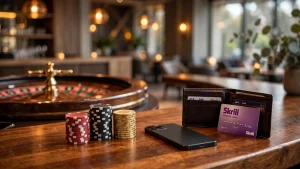
Osko and other cashier options describe payment features, while Australian rules distinguish casino-game supply from how deposits are processed.

For someone in Australia looking for online pokies, the first distinction is between the games themselves and the service that offers them. Under the Interactive Gambling Act 2001, operators must not provide real-money online casino games to people in Australia. That prohibition covers pokies as well as other casino-style games. Calling a service a mobile casino, an online casino or an Australian pokies site does not change the legal boundary.
The law is directed at the supply of these services to people physically located in Australia. It is not a rule that makes an online casino lawful simply because its website uses Australian currency, addresses Australian customers or can be viewed on a phone. Nor does the location of a player outside a casino building alter the central point: offering real-money casino games to customers in Australia is prohibited.
That can be easy to lose sight of when payment terms appear alongside game-related language. A reference to Osko, a bank-linked payment option or a mobile-friendly cashier would describe a payment feature, not the legal status of the casino service. Payment convenience cannot make a prohibited service lawful. The same applies to labels such as “Australian online pokies” or “best Australian online casino”: words on a page do not establish that a provider is authorised to offer real-money casino games in Australia.
When looking for casino sites that accept Osko in Australia, check the available payment details and licensing information before choosing where to play. This list offers a concise reference to the details provided for each site.
Uptown Pokies
Uptown Pokies has operated since 2017 under a Curacao licence. Its stated minimum deposit is A$20.
Vegaz Casino
Vegaz Casino lists Curacao licence OGL/2024/1335/0780. Its stated minimum deposit is EUR 20.
Roby Casino
Roby Casino is licensed by Curacao eGaming, with Roby Games Ltd identified in the licensing details.
Lucky Dreams
Lucky Dreams is licensed in Curacao and lists a minimum deposit of A$20 via POLi.
Thor Casino
Thor Casino lists a Curacao licence from Antillephone N.V., with Versus Odds B.V. also named. Its stated minimum deposit is EUR 20.
LevelUp Casino
LevelUp Casino lists Curacao eGaming licence OGL/2023/174/0082 under Dama N.V. Its stated minimum deposit is A$15.
SpinsUp
SpinsUp lists Curacao Gaming Control Board licence OGL/2023/174/0082 under Dama N.V.
DragonSlots Casino
DragonSlots Casino lists a Curacao Gaming Authority licence, with Jumpman Gaming Ltd named in its licensing details.
Rollero Casino
Rollero Casino lists Curacao Gaming Control Board licence OGL/2023/176/0095 under Hollycorn N.V.
GoldenCrown
GoldenCrown lists Curacao Gaming Control Board licence OGL/2023/176/0095 under Hollycorn N.V.
The Australian Communications and Media Authority (ACMA) is responsible for enforcing the Interactive Gambling Act. Its role is relevant because the restriction is not merely a private policy set by individual operators. It is part of Australian law, and enforcement sits with a national regulator. For readers, the practical takeaway is straightforward: casino-style games offered for real money to people in Australia fall within the prohibited category, regardless of whether the games are described as pokies, slots or another casino format.
The Act’s prohibition on providing these services should not be confused with an explicit criminal offence for an individual who uses an offshore gambling site. The law does not explicitly criminalise players for that use. That distinction is important, but it is not an endorsement of offshore gambling or a guarantee that using such a site is safe.
In particular, Australian consumer law does not protect players who use offshore casinos. If a dispute arises over an account, a payment or access to funds, a player may not have the consumer protections they would expect when dealing with a business operating under Australian rules. The lack of player criminalisation is therefore not the same as legal approval, local oversight or reliable recourse. Those are separate questions.
A careful reading avoids two opposite errors. One is to say that Australian players are explicitly criminalised by the Interactive Gambling Act for using an offshore casino; that is not what the Act states. The other is to treat the absence of an explicit player offence as permission to use the service. The operator-facing prohibition remains, and the consumer-protection gap remains relevant to anyone considering what an offshore service means in practice.
This is also why a payment method should not be used as a shortcut for judging legality. A transaction being technically possible would not demonstrate that the underlying gambling service is lawful. Equally, a payment label does not show that a provider has Australian consumer protections or that a player has an effective route to resolve a complaint. The legal status of the service and the mechanics of a payment are different matters.
For the same reason, terms such as “Australian Osko mobile casino” can blur distinct issues. “Australian” might refer to the intended audience, a currency setting or a marketing description; it does not, by itself, establish lawful provision. Osko is a payment-related term, while the Interactive Gambling Act concerns the offering of interactive gambling services. Keeping those questions separate makes the boundary easier to understand.
If you are assessing information about online pokies, start with the service being described, not its branding. Ask whether it offers real-money casino games to people located in Australia. Under the Act, that is the decisive legal concern for the operator. Payment features, game names and claims about Australian suitability do not override it. And although a player is not explicitly criminalised simply for using an offshore site under this law, Australian consumer law does not protect that player in the way it would protect customers dealing with an Australian-regulated business.
Legal Risk
Under the Interactive Gambling Act 2001, operators are prohibited from providing real-money online casino games to people in Australia, and Australian consumer law does not protect players using offshore casinos.
The distinction is narrow but consequential: the law prohibits operators from offering real-money online casino games to people in Australia; it does not explicitly criminalise players for using offshore sites. Neither point should be stretched into a promise of legality, protection or recourse. Know which side of the transaction the rule addresses—and what protections are absent. That is the boundary.
A payment option appearing in a description does not establish that it is available to every customer or for every transaction. Acceptance can depend on the operator’s arrangements and the payment method’s own requirements. This matters when assessing claims about Osko: a reference to bank-linked payments is not, by itself, confirmation that Osko can be used. Nor does a search for a particular deposit amount establish that an operator accepts that amount.
There is also a more fundamental point for Australians. Under the Interactive Gambling Act 2001, operators must not provide real-money online casino games to people in Australia. This includes casino-style games such as pokies. Information about payment checks should not be read as an invitation to make a deposit or as confirmation that a casino service is lawful to provide to Australian residents.
Online casinos commonly require customers to complete a Know Your Customer assessment before carrying out financial transactions. KYC is an identity-verification process. Its completion is a prerequisite an operator may set for handling financial activity; having a payment method listed does not show that a customer has passed that assessment.
Keep the distinction clear: payment acceptance and customer eligibility are separate questions. A payment option might be described as available, while a transaction could still depend on the operator’s identity-check requirements. Conversely, completing an identity assessment does not establish that a particular payment method is accepted. Neither statement should be treated as a guarantee that a deposit will be processed.
Those details should not be assumed. A claim about an identity process is only useful when it explains the actual requirements that apply; a generic mention of verification does not tell you what a customer would need to provide.
When reviewing a payment claim, identify what it actually confirms. Does it say that a method is accepted, or only that the operator supports bank-linked payments in some form? Does it refer to deposits, withdrawals, or both? These are not interchangeable. A payment method’s general presence in a cashier does not necessarily confirm that it can be used for every type of transaction.
For Osko, the wording deserves particular care. A broad statement about bank transfers or Australian payment services does not prove that a casino accepts Osko specifically. Likewise, the appearance of Osko in a search phrase or a promotional description is not evidence of a working payment option. Treat the method name as a specific claim to verify, rather than filling in the gaps from the fact that a service is familiar in Australia.
The same care applies to minimum-deposit claims. A figure attached to a payment option may describe a particular operator’s terms, not a general rule. It should not be assumed to apply to other operators or to remain current. A stated amount also says nothing on its own about customer verification or the legality of an operator’s service.
A specialist review has reported that American Express deposit and withdrawal limits are set by individual casinos and can differ. That is a payment-specific example of why limits should not be generalised across operators. It does not establish anything about Osko limits, and it is not a basis for assuming that any casino service is available to Australians.
A useful assessment separates three points: whether a payment method is named, whether it is stated to be accepted for deposits, and whether the customer has met the operator’s transaction prerequisites. Combining those into one assumption is where misleading certainty creeps in. A named method is not proof of deposit eligibility; a deposit claim is not proof that KYC is complete.
If an operator’s wording is unclear, ambiguity should not be treated as confirmation. In particular, “bank payment” is broader than “Osko,” and “payments supported” may not say which transaction types are covered. The precise wording matters. So does the context: a page may describe a method generally without confirming that it applies to a specific customer or account.
For Australians, there is an additional consumer risk. Australian consumer law does not protect players who use offshore casinos. That makes confident-looking payment language especially poor substitute for clear terms: it does not create local protection or make the underlying service lawful.
The practical conclusion is narrow. KYC can be required before financial transactions, while payment availability and limits can vary by operator. Those points answer different questions. Neither confirms that Osko is accepted, and neither changes the legal restriction on operators providing real-money online casino games in Australia.
Check the claim’s scope. Do not infer the rest.
A payment that reaches an account quickly is not necessarily a payment method that can also carry a withdrawal quickly. Deposits and withdrawals are separate transactions, and the rules for one do not establish the rules for the other. That distinction matters when you see a claim about an instant casino payout: it may refer to processing at one stage, a particular payment method or an operator’s own procedure, rather than the full time until funds are available.
Deposits and withdrawals are separate transactions; a fast deposit does not guarantee a fast withdrawal or that the same method can be used for payouts.
Amex provides a clear illustration of why the two directions should be assessed separately. A specialist review reports that Amex casino withdrawals can take up to five days to clear. That figure is specific to the Amex withdrawal information described there; it is not a general payout estimate for every payment method or casino. Nor does it tell you how long an operator takes to review a withdrawal before sending it. “Cleared” and “requested” are not interchangeable milestones.
The eligibility condition is separate again: an Amex withdrawal requires a previous deposit using Amex. A method shown in a deposit menu therefore does not, by itself, establish that winnings can be returned through it. Likewise, a fast deposit would not remove the previous-deposit condition or establish a withdrawal timeframe. Deposit speed tells you about money moving into an account; withdrawal eligibility and clearance concern money moving out.
When assessing a payment claim, keep three points distinct:
| Point to check | What it establishes |
|---|---|
| Deposit availability | Whether that payment method is offered for adding funds |
| Withdrawal eligibility | Whether it can be used to receive funds, and whether a qualifying deposit is required |
| Withdrawal timing | How long the withdrawal process or transfer may take |
These are not technicalities. They describe different parts of the transaction. If a method is accepted for deposits but not withdrawals, the deposit option cannot be treated as evidence of a matching cash-out route. If a withdrawal is permitted only after a deposit with that same method, acceptance alone is still not enough. And even where a withdrawal route exists, the time to clear needs its own answer.
The same discipline applies when the payment method in a claim is Osko. An Amex clearance estimate does not establish how an Osko withdrawal performs. It cannot be carried across simply because both methods appear in a discussion of casino payments. Payment rails have different eligibility rules and handling, and a speed claim for one does not prove a speed claim for another. “Instant” needs to identify the relevant transaction and stage, not just sound reassuring.
For a reader comparing claims about instant Osko withdrawals, the useful questions are therefore practical: does the claim concern a deposit or a withdrawal; does it describe the operator’s processing or the time for funds to clear; and is the stated method actually available for withdrawals? If those details are absent, the word “instant” does not answer the timing question. It certainly does not turn Amex information into Osko evidence.
There is also a legal boundary that payment terminology cannot change. Under the Interactive Gambling Act 2001, operators must not provide real-money online casino games to people in Australia. Australian consumer law does not protect players who use offshore casinos. A payment description should not be read as an endorsement, a guarantee of access or a substitute for that legal context.
The careful comparison is not “fast deposit equals fast withdrawal”. It is deposit speed versus withdrawal eligibility versus clearance time. For Amex, the cited specialist review gives a possible clearance period of up to five days and specifies that a prior Amex deposit is required for an Amex withdrawal. Those details illustrate why payout claims need to be method-specific. They do not establish the performance of Osko, or a universal timetable for casino withdrawals.
Keep the stages separate. That is the useful test.
A payment method cannot change the legal status of an online casino service. Whether a cashier lists Osko, a card or another option does not determine whether an operator may lawfully offer real-money casino games to people in Australia. The relevant distinction is between the operator’s conduct and the position of an individual player.
Under the Interactive Gambling Act 2001, providing real-money online casino games to people in Australia is prohibited. The rule covers casino-style services such as poker, table games and pokies. It is the operator’s act of making those services available to people here that creates the central legal issue; a payment label does not create an exception.
The law does not explicitly make an Australian player’s use of an offshore casino a criminal offence. That is a narrower point than saying an offshore service is lawful in Australia. A player’s lack of explicit criminal liability does not authorise the operator to offer the service, and it does not make the arrangement equivalent to using a locally regulated casino. Different parties, different legal position.
The Australian Communications and Media Authority (ACMA) oversees enforcement of the Interactive Gambling Act. Its role concerns the law’s restrictions on prohibited interactive gambling services. The existence of a payment route, or a successful transfer, is not evidence that a service is permitted under Australian law. Nor does a cashier’s wording establish that a provider has legal standing to offer casino games to Australian residents.
That distinction matters when assessing claims about casino sites that accept Osko in Australia. Such wording describes a payment feature, not a legal status. Even if an operator were to state that it accepts an Australian bank-linked payment, that would not show that its casino service can lawfully be offered here. Payment availability and legality are separate questions; one cannot answer the other.
There is a further practical consequence for consumers. Australian consumer law does not protect people using offshore casinos. If a dispute arises over an account, a transaction or winnings, you should not assume that Australian consumer protections apply simply because you are in Australia or used an Australian payment channel. A familiar local transfer method does not turn an offshore gambling service into a locally protected one.
This also limits what can responsibly be inferred from a list of payment options. A payment method may be named without explaining the operator’s legal position, the protections available to a customer or whether the service is permitted to target Australians. Those are not minor details to be settled by a cashier page. They concern the legal framework around the service itself.
If you are comparing payment claims, keep the criteria separate: a method’s stated availability is one question; whether the operator may offer real-money casino games to people in Australia is another; and whether Australian consumer law protects you is a third. A single “yes” on the payment question cannot stand in for answers to the other two. Useful distinction.
A useful comparison separates three questions: whether a payment method is accepted, how quickly a transaction is processed, and what fees may apply. A method that scores well on one measure may not be the strongest choice on another. There is no single “best” option without a criterion.
| Criterion | Visa compared with Amex | Cryptocurrency |
|---|---|---|
| Acceptance | A specialist review reports that Visa may be accepted more broadly than Amex at Australian online casinos. | Availability depends on the service being assessed; the speed and fee information alone does not establish acceptance. |
| Transaction speed | No general speed comparison between Visa and Amex follows from acceptance alone. | Bitcoin and Ethereum deposits and withdrawals can be instant. |
| Fees | Acceptance does not establish whether a transaction is free. | Fees can be limited or absent. |
The card comparison is about potential reach, not a promise that either card will be accepted by a particular service. “More broadly accepted” is also a relative measure: it does not tell you whether a given cashier lists Visa, Amex, both or neither. If acceptance is your priority, treat the specialist review’s comparison as a point to verify, not as a substitute for checking the payment options presented by the operator.
Speed needs its own column. A cryptocurrency transfer may be instant, but that does not answer whether the method is available where you are looking, or whether the service supports both deposits and withdrawals through it. The stated speed applies to cryptocurrency transactions; it should not be transferred to Visa, Amex or Osko by association. Similar names in a payment menu are not evidence of similar processing.
Fees are another separate measure. Bitcoin and Ethereum are described as involving limited or no fees, but that wording does not mean every transaction is fee-free. Nor does it establish a fee comparison with card payments. For a fair comparison, read the fee information alongside the transaction method rather than assuming that speed determines cost.
Reportedly accepted more broadly than Amex at Australian online casinos.
Offers potential for instant deposits and withdrawals with limited or no fees.
Acceptance varies by operator; some casinos may not accept it for deposits or withdrawals.
If you are assessing a service described as an Osko casino, the label alone does not settle the comparison. Consider what you are trying to optimise: breadth of acceptance, transfer speed or fees. Then check whether the payment method is actually offered and whether the stated terms cover the transaction you need. A fast deposit, for instance, is not by itself evidence of a fast withdrawal.
The practical ranking therefore changes with the criterion. Visa may have an acceptance advantage over Amex according to a specialist review, while cryptocurrency has the stated advantage on potential speed and low fees. Neither comparison confirms that a method is available at any particular casino. Acceptance, speed and cost are different tests. Separate columns help.
Payment habits in Australia span cards, mobile wallets and services connected to bank accounts. Contactless credit and debit cards are accepted almost everywhere in everyday commerce, as are mobile wallets such as Google Pay and Apple Pay. That familiarity gives consumers several ways to pay without tying every transaction to the same channel.
People are also comfortable moving between these options and bank-linked services such as PayPal. The choice can depend on what is available at the point of payment and which method the person prefers. Familiarity with a channel, however, is not proof that every online service supports it.
That distinction matters when you are considering an Osko casino payment. Osko belongs to the broader conversation about bank-linked ways of moving money, but general Australian payment habits do not establish whether a particular gambling service supports Osko. Nor do they establish how a transaction would work there. A search for casino games using Osko cannot be answered simply by pointing to the widespread use of cards, wallets or bank-linked services across Australia.
Think of the payment landscape in two layers. The first is what consumers commonly use across the country: contactless cards, mobile wallets and services such as PayPal. The second is what an individual online service permits. The first layer describes everyday familiarity; it does not settle the second. A payment option that feels routine in shops may not be offered by a given website, while a bank-linked service being familiar does not confirm that Osko is available.
This is a useful way to read claims about Osko casino payment options. Treat them as specific claims about a particular service, not as a consequence of Australian consumers being comfortable switching among payment channels. The same caution applies to searches for Osko slot games: familiarity with a payment method says nothing by itself about whether a game or service accepts it.
Australian payment habits involve a two-layer system: general consumer familiarity with contactless cards and mobile wallets, and the specific payment methods an individual online service chooses to permit.
The practical comparison is therefore not simply “cards versus wallets versus bank-linked payments.” It is what Australians recognise and use generally, compared with what a specific service actually makes available. Those are different questions. Familiarity is not acceptance.
A payment method being familiar in Australia does not mean every casino accepts it. Availability is decided by the individual operator, so a general label such as “Australian casino payments” cannot tell you which options will appear in a particular cashier. This is especially important when you are looking for an Australian casino using Osko: do not treat acceptance at one service, or general use of bank-linked payments, as proof that another accepts it.
The same variation applies to cards. A specialist review reports that some online casinos do not accept American Express, while deposits with Amex are available at some Australian online casinos. Those statements describe different operators, not a contradiction. They also should not be read as a permanent directory: payment arrangements can change, and a method mentioned in a review may not be listed by another operator.
| What you want to know | What a general claim can establish |
|---|---|
| Whether a casino accepts a particular method | Only the operator’s own current payment information can settle that for that service |
| Whether a method is used by Australian consumers | It does not establish casino acceptance |
| Whether one casino accepts Amex | It does not establish acceptance at other casinos |
That distinction matters for searches about Osko casino options. “Bank-linked” is a broad category, not a promise of a specific payment route. Nor does a casino accepting one bank-related service mean it accepts all of them. Treat claims about an “all Osko casino” list with particular care: a category-wide label cannot replace operator-specific terms.
For Amex, the practical comparison is similarly narrow. Some operators may list it for deposits; others may not. An acceptance claim should therefore identify the specific operator and transaction type rather than imply that Amex is standard across Australian-facing casinos.
Payment acceptance is not a safeguard or endorsement. The Interactive Gambling Act 2001 prohibits operators from providing real-money online casino games to people in Australia, and Australian consumer law does not protect players using offshore casinos. Availability is not protection.
A payment method appearing in a cashier for deposits does not establish that it can also receive withdrawals. A specialist review reports that some Australian-facing online casinos do not permit withdrawals to Amex. Treat that as a reason to check the operator’s written rules, not as a complete or permanent map of what is available.
The same distinction matters when you are checking an Osko withdrawal. A deposit route and a payout route are separate permissions: do not assume that being able to send money through a bank-linked service means you can receive a withdrawal through it. The rules need to name the method for the transaction you intend to make. A general reference to bank payments is not specific enough.
Attention: A payment method appearing in a cashier for deposits does not establish that it can also be used to receive withdrawals.
Limits are another separate condition. A specialist review reports that individual online casinos set their own Amex deposit and withdrawal limits, and that those limits can vary. That does not tell you what a particular operator currently permits, nor does an Amex limit establish an Osko limit. Check the relevant terms and cashier information for the payment method and direction of travel: deposit or withdrawal.
A useful comparison table has three columns: method, accepted for deposits, and accepted for withdrawals. Add the applicable limits only when the operator states them clearly. If a method is listed only under deposits, leave its withdrawal status unconfirmed rather than treating the two as interchangeable. That small distinction can prevent a payout plan from resting on an assumption.
These are practical payment conditions, not a recommendation to use an offshore casino. Australian law prohibits operators from providing real-money online casino games to people in Australia. Australian consumer law does not protect players who use offshore casinos. Check the legal position before making any decision.
A card payment can fail for reasons beyond the casino’s cashier. Australian banks may block gambling-related Amex transactions at the issuer level, so a declined payment does not necessarily mean the card details were entered incorrectly. The issuer’s decision and the casino’s own payment rules are separate checks.
A specialist review reports that Amex deposits may carry no fee, but that should not be treated as a universal price. The casino’s terms determine whether a charge applies, and a withdrawal may have a fee even when a deposit does not. Check the applicable fee information before making a financial decision; a payment method’s deposit cost does not settle the cost of withdrawing funds.
That distinction matters because “no deposit fee” is not the same as “no transaction costs”. Currency conversion or other charges may also be relevant under the card and account terms. Do not assume a cashier’s displayed deposit amount is the only possible cost.
Osko is a different kind of payment channel from a card. Information about Amex charges or issuer blocks cannot establish whether a particular casino accepts Osko, or what terms would apply to it. If you are comparing ways to pay, treat acceptance, deposit charges, withdrawal charges and issuer restrictions as separate criteria. The apparent winner depends on which condition matters to you.
A card issuer’s block is not something the casino can necessarily reverse. If a transaction is declined, check with the issuer rather than repeatedly submitting it; repeated attempts do not change the issuer’s restriction. A hard stop.
These details describe payment conditions, not an endorsement of online casino services. The legal position for operators and the protections available to people using offshore sites are separate issues. In particular, Australian consumer law does not protect players who use offshore casinos. Payment convenience does not alter that exposure.
Osko is a payment service, not a feature of an individual game. A reference to Osko alongside online pokies therefore does not establish that a particular game accepts that payment method. Payment arrangements, where offered, relate to an operator’s account or cashier rather than to a game title.
That distinction matters when you encounter claims about online games that accept Osko. A payment logo or mention of a bank-linked service does not tell you whether it applies to a specific game, whether it covers deposits and withdrawals, or whether a transaction would be available to someone in Australia. Those are separate questions, and the wording alone cannot answer them.
There is also a more important boundary than payment convenience. Under the Interactive Gambling Act 2001, operators cannot provide real-money online casino games, including pokies, to people physically located in Australia. Australian consumer law does not protect players who use offshore casino services. A payment label does not change either point.
So treat “Osko pokies” as a loose description, not proof of game-specific payment support or a signal that a service is lawful for Australians. Avoid interpreting payment claims as an endorsement or invitation to use an online casino. The game and the payment method are different things; neither wording nor branding turns them into a permitted Australian service.
Check whether American Express is listed in the casino’s cashier. Some casinos do not accept it, and availability can vary.
Your card issuer may be blocking gambling transactions, or American Express may be blocking payments to that website. Check with your issuer about the declined transaction.
Each casino sets its own Amex deposit and withdrawal limits, so check the limits shown in that casino’s cashier. Amex limits are usually higher than those for Visa and Mastercard.
Jackpot City Casino, Spin Palace, Ruby Fortune, Ignition Casino, Joe Fortune and PlayAmo are listed as supporting Amex deposits. Acceptance can vary, so check the cashier. Australian law prohibits operators from offering real-money online casino games to people in Australia.
Some casinos allow Amex withdrawals, but not all do, and you generally need to have deposited with Amex first. Withdrawals can take up to five days to clear, and fees may apply.
Yes, at a casino that accepts American Express, but an Amex gift card can be used for deposits only.
Amex deposits are typically free, but a casino may add a 1.5% surcharge, and a 3% currency conversion fee may apply. Withdrawal fees may also apply.