Everyday use of mobile wallets in Australia does not confirm that a particular online service accepts them for deposits or withdrawals.
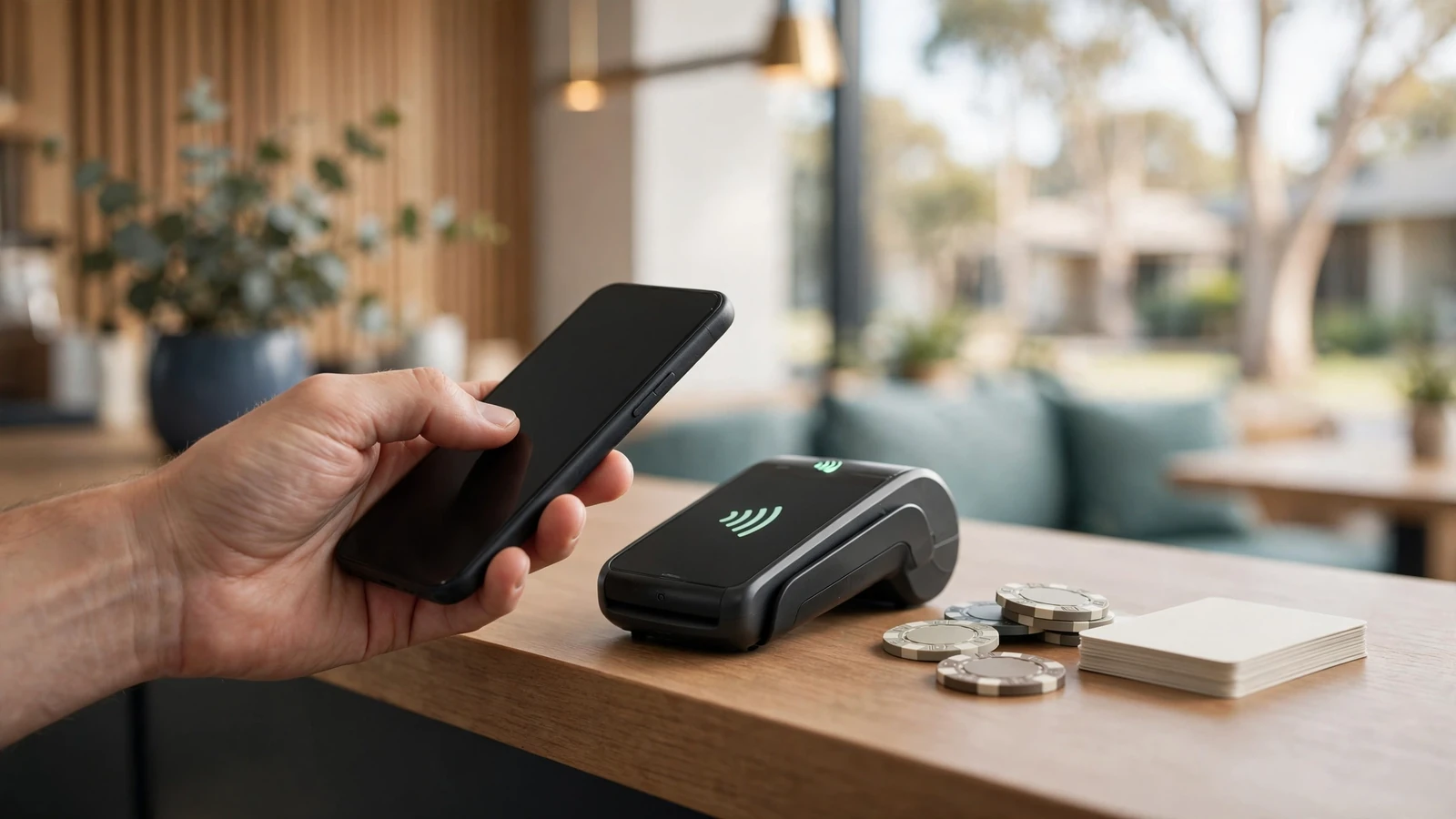
In Australia, paying by tapping a card or phone is part of ordinary retail life. Contactless credit and debit cards are accepted across almost the entire country, while Google Pay and Apple Pay have similarly broad everyday use. That familiarity shapes expectations: if a phone can handle routine purchases, it can seem natural to expect the same option wherever an online payment is involved.
The practical question is more specific than whether Australians use Google Pay. They do, alongside physical cards and other ways of paying. The question is whether a particular service accepts that method in the particular context you have in mind. Broad familiarity with a payment tool describes the country’s habits; it does not by itself settle what any individual online service supports.
Australian consumers are accustomed to moving between payment types rather than relying on a single one. You might use a card for one purchase, a mobile wallet for another, and a bank-linked service such as PayPal elsewhere. That flexibility makes switching feel unremarkable. The phone is not necessarily replacing the card; it is another way to access a payment method when the situation suits.
If you’re looking for an Australian casino that accepts Google Pay, check the payment options available to you before depositing, as the details here do not confirm Google Pay support. Use this list as a starting point and consider each operator’s stated licence and any available deposit information.
Uptown Pokies
Uptown Pokies has operated since 2017 under a Curacao licence. Its stated minimum deposit is A$20.
Vegaz Casino
Vegaz Casino lists Curacao licence OGL/2024/1335/0780. Its stated minimum deposit is EUR 20.
Roby Casino
Roby Casino is listed as licensed by Curacao eGaming under Roby Games Ltd. No deposit details are provided here, so check the casino’s payment information directly.
Lucky Dreams
Lucky Dreams lists a Curacao licence and a minimum deposit of A$20 via POLi. The available information does not confirm Google Pay support.
Thor Casino
Thor Casino is listed under a Curacao licence held by Antillephone N.V. for Versus Odds B.V. Its stated minimum deposit is EUR 20.
LevelUp Casino
LevelUp Casino lists Curacao eGaming licence OGL/2023/174/0082, held by Dama N.V. Its stated minimum deposit is A$15.
SpinsUp
SpinsUp is listed under Curacao Gaming Control Board licence OGL/2023/174/0082, held by Dama N.V. The available details do not include deposit or payment-method information.
DragonSlots Casino
DragonSlots Casino is listed under the Curacao Gaming Authority, with Jumpman Gaming Ltd named. No deposit or payment-method details are provided here.
Rollero Casino
Rollero Casino lists Curacao Gaming Control Board licence OGL/2023/176/0095, held by Hollycorn N.V. The available information does not specify deposit or payment options.
GoldenCrown
GoldenCrown lists Curacao Gaming Control Board licence OGL/2023/176/0095, held by Hollycorn N.V. No deposit or payment-method details are provided here.
This matters when you assess whether Google Pay is relevant to an online casino. A familiar wallet may be part of your everyday routine, but familiarity does not make it interchangeable with every other payment option. Cards, mobile wallets and bank-linked services sit within the same broad payment landscape, yet they remain distinct choices. The fact that you are comfortable using all three does not mean a service treats them as equivalent.
Think of everyday acceptance as the background, not the answer. Across Australian shops and services, contactless payments are widespread enough to feel normal. That provides context for why someone may look for a mobile wallet when considering an online payment. It does not establish that the wallet is available for every type of transaction or at every service.
A phrase such as “Google Pay casino” brings two familiar ideas together: a payment method used around Australia and an online service a person is trying to understand. It is easy to read that combination as a straightforward compatibility question. But the country’s payment habits describe what consumers commonly use across everyday commerce, not what an individual online operator accepts.
Keeping those two levels separate helps you interpret claims more carefully. One level is national behaviour: Australians widely use contactless cards and mobile wallets, and they are used to switching between payment options. The other is a particular service’s arrangements. General patterns can explain why Google Pay is a natural point of interest, but they cannot answer that service-specific question on their own.
This is a useful distinction even before you compare any payment details. A mobile wallet’s popularity is evidence of consumer familiarity, not a guarantee of universal availability. The same applies to cards: their broad acceptance in daily life does not tell you that every online service will support every card type. The method you prefer and the options available in a given setting are related, but they are not identical.
If convenience means using a payment method already familiar on your phone, a mobile wallet may be an appealing choice. If it means keeping several ways to pay available, the Australian pattern of switching between cards, wallets and bank-linked services is more relevant. Which approach suits you depends on what you value; there is no single winner without a criterion.
That comparison is about habits, not a promise that one method works everywhere. Contactless use is widespread, but “widely used” and “available in every setting” are different claims. Australians’ comfort with several payment types makes it easier to consider alternatives, but it does not erase the differences between them.
A simple mental table helps:
| What you are considering | What Australian habits tell you |
|---|---|
| Contactless cards | They are accepted across nearly all of the country. |
| Mobile wallets | Google Pay and Apple Pay are part of everyday payment use on a similarly broad scale. |
| Switching methods | Consumers commonly move between cards, wallets and bank-linked services such as PayPal. |
| A specific online service | General payment habits alone do not establish which options it supports. |
The final row is the boundary that matters. A national pattern can explain why Google Pay feels like a sensible option to look for, but it cannot stand in for information about a particular service. Treat the broad Australian context as useful orientation, not as confirmation.
That distinction also keeps the question grounded. Australians are not choosing between a modern method and an unfamiliar one; cards, mobile wallets and bank-linked services all form part of a familiar mix. The relevant comparison is which method fits the setting and the user’s priorities—not which one is most visible in everyday life.
So, when you see mobile-wallet use reflected in your own routines, it is reasonable to expect the option to be familiar. It is not reasonable to infer from that alone that every online setting supports it. Familiarity explains the expectation. The specific service determines whether that expectation applies.
A useful starting point, then, is to separate comfort with Google Pay from its availability in a particular context. Australian payment habits make the interest understandable: tapping a phone is ordinary, and switching between payment types is ordinary too. But the broad habit and the specific option remain separate questions. Familiar, not universal.
A deposit method should be assessed by what the cashier actually displays, not by a general claim that a site supports digital payments. Google Pay appearing in a payment description, an advert or a wallet list does not by itself establish that it is available for a particular transaction. The relevant details are the method shown to you, the currency and amount fields, and the terms attached to the payment.
For people searching for a casino deposit via Google Pay, the distinction matters: broad mobile-wallet use in Australia does not confirm that an online casino accepts Google Pay. Nor does a description of another payment method prove anything about Google Pay. Treat each method as a separate claim, and do not assume that a wallet will appear at checkout just because a site mentions it elsewhere.
Before relying on a payment option, check whether the cashier names it directly and whether its instructions match the transaction being described. Look for the stated currency, any displayed fees, and the deposit limits that apply to that method. If the terms are unclear or conflict with the cashier, the payment claim has not been explained clearly enough to base a decision on.
Amounts deserve particular care. A search phrase such as “$10 Google Pay deposit” is not evidence that a cashier accepts that amount or that Google Pay is available. The minimum and maximum allowed can depend on the operator and payment method, and figures shown in general promotional copy may not describe the current cashier. Use only information shown in the relevant transaction terms; do not infer a limit from another method or another site.
A specialist review has reported that American Express deposits are available at some Australian online casinos. That is a limited, time-sensitive claim about Amex, not proof of general acceptance and certainly not evidence that Google Pay is supported. Availability can change, so a review should not substitute for the payment information presented by the operator. It is also not a recommendation to use an online casino.
The documented Amex process illustrates the sort of steps a cashier may describe. The player selects Amex, enters the card details and deposit amount in Australian dollars, then submits the payment. This is an example of a card transaction flow only. It does not show that Google Pay can be selected, that a digital wallet follows the same steps, or that any particular casino supports either method.
The sequence also shows why a payment-method name alone is not enough. A reader needs to know what information the cashier requests, what currency the amount field uses and what happens when the payment is submitted. Those details should belong to the method actually being used. Do not transfer instructions from an Amex card form to a Google Pay checkout; the two are not interchangeable simply because both may involve a phone or a digital payment.
Amex deposits at casinos are described as processing instantly. That timing applies to the Amex deposit claim, not to Google Pay, and it should not be read as a guarantee for every transaction. A displayed processing time is useful only when it is clearly attached to the method and transaction in question. Neat distinction.
Deposit limits are set by individual online casinos and can vary. Check the terms for the relevant method rather than assuming that one limit applies across all payment choices. If the cashier shows a range, confirm that it is stated in the same currency as the amount you intend to enter. If no limit or currency is clear, do not fill the gap with a figure found in an unrelated payment guide.
Fees should be treated with the same care. A fee statement needs to identify the payment method and the transaction it covers. A general claim that deposits are free does not establish that every method is free, while a fee attached to one method should not be attributed to another. If a charge appears before submission, read how it is described; if the terms do not explain it, the cost is uncertain.
A useful comparison is therefore not a list of wallet names. It is a small record of what the cashier says for each method: whether it is named, which currency is used, what limits are stated, whether a fee is disclosed and what processing description applies. Do not mark Google Pay as accepted just because a site has a general wallet reference. Record it only if the cashier’s own payment information identifies it for the transaction.
Finally, this checklist describes how to interpret payment information; it is not an invitation to deposit with an offshore casino. Australian law prohibits operators from offering real-money online casino games to people in Australia, and Australian consumer law does not protect players using offshore casinos. A clear-looking cashier does not change that legal position. If the point of checking is to establish whether a Google Pay deposit is available, keep the answer narrow: only a direct, current statement about Google Pay supports that specific claim.
Legal Warning
Australian law prohibits operators from offering real-money online casino games to people in Australia, and consumer law does not protect players using offshore casinos.
A payment logo on a webpage is not the same as confirmation that you can use that method from Australia. Google Pay is accepted almost everywhere in Australia in everyday settings, but that broad availability does not establish acceptance by a particular online casino. The distinction is simple: a wallet’s popularity tells you about the local payment landscape, not an operator’s cashier.
Assess each claim against the actual payment options presented to Australian customers. Look for Google Pay to be named explicitly, rather than relying on a general “mobile payments” label or a row of familiar wallet logos. Those labels can group together methods that are not interchangeable. If Google Pay is not identified clearly, treat the claim as unconfirmed rather than assuming that a phone-based payment option means Google Pay.
The most useful evidence is a current cashier or payment page that identifies the method and says it is available to customers in Australia. General statements such as “multiple payment options” do not tell you which options are supported. Nor does a page that describes Google Pay as widely used in Australia prove that the casino accepts it.
Check that the wording relates to the service you are evaluating, not to another product or a different country. A payment page can describe what the operator supports in broad terms without confirming that every method is available to every customer. Country-specific wording matters. So does the distinction between a payment method being mentioned in an article and being offered by the operator itself.
If two pages disagree, give more weight to the operator’s current cashier or its payment terms than to a general overview. If the information still conflicts, ask the operator to confirm whether Google Pay is available to Australian customers before relying on the claim. A clear answer is more useful than a polished list of logos.
A compact comparison helps separate a specific claim from a general impression:
| Claim you see | What it establishes |
|---|---|
| Google Pay is popular in Australia | Local familiarity with the wallet |
| “Mobile payments accepted” | Some mobile payment option may be available |
| Google Pay is named in an Australian cashier | A specific, country-relevant acceptance claim |
| A payment method appears only in a general article | The article makes the claim; it does not by itself confirm current availability |
This is a practical way to assess payment claims, not a ranking of casino sites. A “best” choice would depend on the criterion: for payment certainty, explicit and current confirmation matters more than a broad list of methods. If no operator provides that confirmation, there is no sound basis for calling one a better Google Pay option.
Visa may be more broadly accepted at Australian online casinos than Amex, according to a specialist review. That comparison concerns those card networks; it does not establish that either one is accepted by a particular operator, or that Google Pay is supported. Treat it as a reported comparison, not a guarantee or a current market-wide rule. Acceptance can change, so the operator’s current information remains the relevant check.
A method can be familiar, quick to recognise, and widely used in shops without being available in a particular cashier. Those are separate criteria. If convenience is your priority, you may value a wallet you already use; if certainty is the priority, you need an explicit statement that it is available to you. The winner depends on your criterion.
Be wary of claims that blur these distinctions: a page that mentions mobile wallets generally, then implies Google Pay acceptance, has not shown the specific connection. The same applies when a list combines card brands, bank-linked services and phone wallets under a single “supported payments” heading. Ask what is actually named, for whom, and where the confirmation appears.
The useful standard is not how confidently a page presents its payment options. It is whether the specific method is identified, whether the claim applies to Australia, and whether the operator currently confirms it. If any part is unclear, do not treat broad wallet use as proof. Logos are easy. Confirmation is harder.
A payment that reaches an account quickly when you add funds does not necessarily move winnings out at the same pace. Deposits and withdrawals are separate transactions, and the method shown for one does not by itself confirm that the same method is available for the other. That distinction matters when you are comparing claims about instant Google Pay withdrawals in Australia.
The available timing detail concerns Amex, not Google Pay. A specialist review reports that an Amex casino withdrawal can take as long as five days to clear. Treat that as a reported Amex timeframe, not a promise for every operator or payment route. It also says nothing about how long a Google Pay payout takes. A wallet’s broad use for everyday contactless payments does not establish that an online gambling operator supports withdrawals to it.
There is a separate eligibility condition for Amex payouts: the player must have made a previous deposit using Amex. If you have not used Amex to deposit, do not assume that winnings can be sent to it simply because it appears as a payment option elsewhere. Deposit eligibility and payout eligibility are different checks.
| Point to compare | Amex | Google Pay |
|---|---|---|
| Reported payout timing | A specialist review gives a clearance period of up to five days | No timing should be inferred from the Amex report |
| Prior deposit condition | A previous Amex deposit is required for an Amex withdrawal | The Amex condition does not establish a Google Pay rule |
| What to verify | Whether Amex withdrawals are available and what conditions apply | Whether Google Pay is specifically supported for withdrawals |
Use the cashier’s withdrawal options and the operator’s written payment terms to confirm the route before relying on a payout estimate. Check whether the method is available for withdrawals, whether a deposit using that same method is a prerequisite, and how the operator defines processing time. A displayed method for deposits is not proof of a matching withdrawal option.
“Instant” can also describe different stages. A request may be submitted, reviewed, processed by an operator, and then cleared by a payment provider. A claim about one stage does not establish that the money will be available to you immediately. For Amex, the reported period refers to clearing; do not convert that into a general deadline for other methods.
When assessing a claim about an instant Google Pay withdrawal, look for a specific statement about payouts rather than a general reference to Google Pay deposits or mobile wallets. Confirm that the terms apply to Australian customers and that they describe withdrawal availability, not just the ability to pay in. If the wording only says Google Pay is accepted, it leaves the payout question unanswered.
Amex Payout Process
Deposit Requirement
Ensure a previous deposit was made using Amex, as this is a prerequisite for Amex withdrawals.
Request Submission
Submit the withdrawal request through the cashier's available payout options.
Clearance Period
Allow for the reported clearance time, which a specialist review states can take up to five days.
The comparison depends on your criterion. For Amex, the useful points are the reported clearance period and the prior-deposit requirement. For Google Pay, those Amex details provide no payout schedule or eligibility rule. Don’t treat the two as interchangeable.
A search for a casino that takes Google Pay can make payment compatibility seem like the main question. In Australia, the legal position comes first. A mobile wallet does not change whether an online casino service may lawfully be offered to someone in the country.
The Interactive Gambling Act 2001 prohibits operators from providing real-money online casino games to people in Australia. That covers casino-style play such as table games and pokies. The restriction is directed at the operator: the Act does not explicitly make an individual player’s use of an offshore casino a criminal offence. Those points are different, and treating them as the same would give you a misleading picture of the law.
The Australian Communications and Media Authority, known as ACMA, oversees enforcement of the Act. Offshore services may be subject to enforcement action and access restrictions. A site appearing in search results, or displaying a payment option, is not evidence that its service is lawful for Australians. Availability and legality are separate tests.
The lack of an explicit player offence is not the same as legal approval or consumer protection. Australian consumer law does not protect players who use offshore casinos. If a dispute arises, you should not assume that the protections available in an ordinary Australian consumer transaction will apply. An operator’s terms, payment branding or claims about where it is based do not change that position.
This matters when a page presents Google Pay acceptance as a reason to choose a casino. The payment method answers only a narrow technical question: whether a transaction route is offered. It does not establish that the operator may offer casino games to people in Australia, that the service is protected under Australian consumer law, or that a payment claim is accurate. One criterion cannot do the work of another.
There is also a difference between a person facing no explicit criminal liability under this Act and a service being lawful to provide. The law places the relevant prohibition on operators, while ACMA’s enforcement role concerns the Act’s restrictions on services. That distinction is useful, but it should not be turned into an assurance that using an offshore site is safe or endorsed.
So, when you encounter claims about casinos accepting Google Pay in Australia, read them against the legal context rather than as a simple shopping comparison. A wallet label is not a licence, a consumer safeguard or confirmation of lawful availability. The decisive legal point is that operators are prohibited from offering real-money online casino games to people in Australia, while Australian consumer law does not protect players who use offshore casinos.
Payment compatibility comes second. Legal exposure is not the player’s explicit criminal liability under this Act; the more immediate distinction is between an operator’s prohibited service and the limited protection available to a customer using it. That is the frame for assessing any offshore casino claim.
A payment method and a game catalogue answer different questions. Google Pay concerns how a payment might be made; it does not identify which games an operator offers, nor does a game listing show which payment methods are available. Treating these as one feature can make a casino payment claim sound more specific than it is.
Mobile wallets are familiar across Australia: Google Pay and Apple Pay can be used at almost all kinds of local businesses. That broad everyday acceptance does not carry over automatically to every online service. It also cannot confirm that a particular casino accepts Google Pay, or that a specific game can be accessed through a Google Pay transaction. General wallet use is not operator-level evidence.
| What you want to establish | What the information needs to show |
|---|---|
| Whether Google Pay is offered | The operator’s stated payment options |
| Which games are listed | The operator’s game information |
| Whether the two are connected | A clear statement covering both the payment method and the relevant game access |
This distinction matters when you encounter phrases such as “Google Pay casino games.” The wording can refer to a casino that lists Google Pay as a payment option, games available at a casino that accepts that method, or simply a page grouping the two topics. Those meanings are not interchangeable. A reference to mobile casino payments, for instance, does not establish anything about the games themselves.
The comparison is straightforward: use payment information to assess payment availability, and game information to understand what an operator lists. Do not infer that Google Pay unlocks a particular title, changes a game’s features, or verifies the operator’s catalogue. The payment method is not a game attribute.
That is the whole distinction. No hidden link.
If you are checking a claim, look for wording that explicitly states what it covers. A general mention of Google Pay supports only a general payment claim; a list of games supports only a catalogue claim. When a page combines both without explaining the relationship, keep the two details separate rather than treating the combination as proof. That approach is more useful than assuming a payment option determines what appears on screen.
Google Pay’s broad acceptance in Australia can make it seem natural to expect the same option wherever an online service accepts payments. Mobile wallets, including Google Pay and Apple Pay, are accepted almost everywhere in the country. That describes everyday payment habits, not the cashier arrangements of a particular casino.
This distinction matters when a search combines Google Pay with pokies or casino games. Those terms can point to a hoped-for payment option, but they do not confirm that a casino accepts the wallet. Nor do they establish that a particular game can be accessed using it. A familiar payment brand in a phrase is not proof of a working payment route.
The same caution applies when a page pairs Google Pay with a casino bonus. The wording does not tell you whether a promotion exists, what its conditions are, or whether a particular payment method qualifies. Treat the payment claim and any bonus claim as separate details to verify, rather than assuming that one confirms the other. The label alone settles nothing.
A useful way to read such claims is to separate three questions: does the cashier list Google Pay, does the claim apply to the service being described, and are any stated promotional conditions clear? If the wording only mentions Google Pay alongside games or a bonus, it may be describing a topic rather than confirming an available option. Look for a direct statement about the cashier, not an inference from nearby game names or promotional language.
An apparent list of casinos using Google Pay needs the same scrutiny. A list title is not confirmation for every entry, and a general statement about mobile wallets in Australia cannot fill that gap. Acceptance can only be assessed at the individual service level, from its own current payment information.
Keep the comparison narrow: widespread wallet use tells you that Australians are familiar with mobile payments; it does not tell you whether a particular casino accepts Google Pay for any purpose. Game-related wording does not strengthen the payment evidence. Separate the claims, verify each one, and do not treat a shared phrase as a confirmed connection. A small distinction, with practical consequences.
A payment option shown for deposits does not, by itself, tell you how winnings can be paid out. That distinction matters when you are checking whether a casino with Google Pay also supports withdrawals through the same wallet. The cashier’s deposit choices and its payout rules are separate details; seeing a wallet listed for one does not establish that it is available for the other.
For Amex, a specialist review reports that some casinos may not return winnings to the card, while others may attach an additional withdrawal fee. Treat that as a point to verify against the operator’s current terms, not as a rule applying to every Australian-facing site. A separate specialist review also notes that not all Australian online casinos permit withdrawals to Amex. Payment labels alone are not enough.
The useful comparison is between deposit eligibility, payout eligibility and fees. A casino may accept a payment method to fund an account but set different conditions for sending money out. Even where Amex deposits are described as fee-free, a specialist review says fees can depend on the casino and may arise on withdrawals. Check the withdrawal terms specifically; a deposit fee statement does not settle the cost of a payout.
The same distinction applies when you are considering Google Pay. A listing for Google Pay deposits does not confirm a Google Pay withdrawal route, and it should not be read as evidence that winnings can be returned to the wallet. Look for an explicit payout method and any associated charge in the cashier information and terms. If those details are unclear, the method cannot be compared fairly with another option.
Keep the records separate:
That simple check prevents a familiar mismatch: an easy way to pay in, but no equivalent route out. The payout rule is the deciding detail.
Australian consumers are comfortable moving between cards, mobile wallets and bank-linked services such as PayPal. That flexibility can make Google Pay feel like a natural option when considering an online payment. But everyday familiarity with a wallet does not establish that a particular casino accepts it, or that a payment will be authorised.
There is a separate issue at the card-issuer level. Australian banks may block gambling-related transactions made with Amex. In that case, the restriction comes from the bank or card issuer, not necessarily from the wallet or the merchant’s cashier. Adding an Amex card to a digital wallet does not remove an issuer’s decision to block a transaction.
That distinction matters if you are comparing payment methods. A wallet may be available for ordinary purchases while a gambling-related card transaction is declined. Switching the interface from a physical card to Google Pay does not, by itself, change the underlying card or the issuer’s restrictions. Nor does the general popularity of mobile wallets confirm that an Australian casino accepts Google Pay.
For a clear comparison, separate three questions: whether a payment method is displayed by a service, whether the underlying card can be used for that type of transaction, and whether the issuer permits it. A “yes” to one does not settle the others. Payment choice depends on the specific method and the issuer’s rules; there is no universal winner.
This is a practical limitation, not a reason to keep retrying a blocked payment through different wallet screens. And payment access should not be mistaken for legal protection: Australian consumer law does not protect players who use offshore casinos. Check the rules that apply to your situation before making a payment decision.
A payment option appearing in a cashier does not settle every question about whether a transaction can proceed. Online casinos typically require customers to complete a Know Your Customer (KYC) assessment before carrying out financial transactions. That identity check is separate from payment compatibility: completing it does not confirm that Google Pay is accepted, nor does a Google Pay logo establish that a payment will be approved.
If you are assessing a claim about Google Pay at a casino, treat the identity-check process and the payment route as separate criteria. Check what the operator says about verification and whether its cashier explicitly offers Google Pay for the relevant transaction. A general statement that a casino supports mobile wallets is not the same as confirmation that Google Pay works there. Nor does a deposit option establish a route for payouts.
There can also be a card-level failure. A specialist review reports that an Amex deposit may be declined when Amex blocks payments to a particular website. That is a specific possible cause, not proof that every failed transaction has the same explanation. It also says nothing by itself about Google Pay approval or security. Different payment methods can involve different checks and restrictions; one cannot be used to infer the outcome for another.
If a payment fails, avoid treating the failure as evidence that your identity check is incomplete—or that a wallet is accepted but temporarily unavailable. Review the operator’s stated verification requirements and the payment method shown in its cashier, then seek clarification from the relevant provider if needed. Do not assume that switching methods will resolve the issue.
There is an important consumer-protection boundary, too: Australian consumer law does not protect players using offshore casinos. A smooth verification process or a familiar payment logo does not change that position. Check the consequences before sharing personal or payment details. Convenience is not protection.
Check the casino’s cashier for American Express as a deposit option. Some online casinos do not accept Amex.
Yes. Each casino sets its own Amex deposit and withdrawal limits, so they can vary. Amex transaction limits are usually higher than those for Mastercard and Visa.
Some casinos allow Amex withdrawals, but others do not. You generally need to have deposited with Amex first; withdrawals can take up to five days to clear.
Amex deposits typically have no fee, but a casino may add a surcharge. Currency conversion fees may also apply.
Limits are set by each casino and vary. Check the cashier or the casino’s payment terms for its current Amex limits.
Jackpot City Casino, Spin Palace, Ruby Fortune, Ignition Casino, Joe Fortune, and PlayAmo are among the operators listed as accepting Amex deposits for Australian players.
Some casinos allow Amex withdrawals, but not all do, and you generally must have deposited with Amex first. A withdrawal can take up to five days to clear, and fees may apply.