PayID can fund a qualifying deposit, but eligibility, wagering rules and cashout limits depend on the promotion.
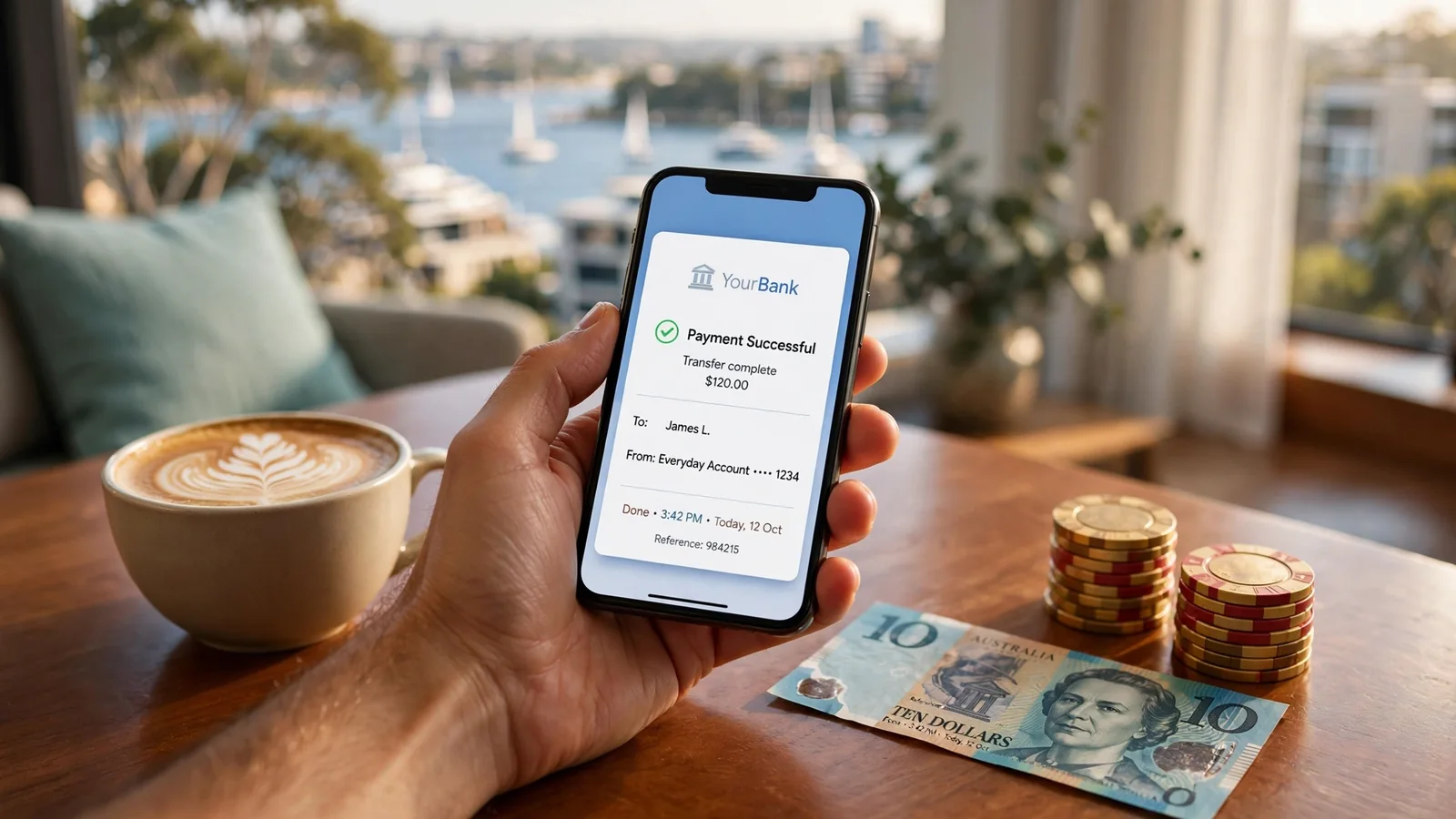
PayID is an Australian payment method that lets you send money using a registered email address or mobile number instead of entering BSB and account details. Transfers are described as settling in seconds, and Australian banks describe PayID deposits as instant and free. That makes it important to separate the payment method from the promotion attached to a casino account: PayID moves a deposit; it does not, by itself, create a bonus.
A $10 PayID deposit offer generally describes a promotion linked to putting $10 into an account through PayID. A deposit bonus depends on a deposit being made, while a no-deposit offer is presented as available without one. The wording can make the two sound similar, but the trigger is different. If an offer says you must deposit to qualify, it is not no-deposit simply because the required payment is small.
That distinction matters when you see phrases such as “$10 casino deposit bonus” or “$10 match bonus.” They point to a deposit-linked promotion, not necessarily cash available to withdraw. The payment amount and the promotional amount are separate parts of the offer. Read the conditions attached to each rather than assuming that sending $10 through PayID means you have received an additional $10 to use freely.
A $10 PayID no-deposit offer can be a useful starting point, but the operator details matter when you decide where to look. Use this list to check the licensing and deposit information provided for each casino.
Uptown Pokies
Uptown Pokies has operated since 2017 and holds a Curacao licence. Its stated minimum deposit is A$20.
Vegaz Casino
Vegaz Casino lists Curacao licence OGL/2024/1335/0780. Its stated minimum deposit is EUR 20.
Roby Casino
Roby Casino is listed as licensed by Curacao eGaming, with Roby Games Ltd named in connection with the licence.
Lucky Dreams
Lucky Dreams holds a Curacao licence and lists a minimum deposit of A$20 via POLi.
Thor Casino
Thor Casino is listed under a Curacao licence associated with Antillephone N.V. and Versus Odds B.V. Its stated minimum deposit is EUR 20.
LevelUp Casino
LevelUp Casino lists Curacao eGaming licence OGL/2023/174/0082, with Dama N.V. named as the operator. Its stated minimum deposit is A$15.
SpinsUp
SpinsUp lists a Curacao Gaming Control Board licence, OGL/2023/174/0082, associated with Dama N.V.
DragonSlots Casino
DragonSlots Casino is listed as licensed by the Curacao Gaming Authority, with Jumpman Gaming Ltd named in connection with the licence.
Rollero Casino
Rollero Casino lists Curacao Gaming Control Board licence OGL/2023/176/0095, associated with Hollycorn N.V.
GoldenCrown
GoldenCrown lists Curacao Gaming Control Board licence OGL/2023/176/0095, associated with Hollycorn N.V.
A no-deposit offer, by contrast, does not require a deposit as its stated entry condition. It may be advertised alongside deposit promotions, so the label alone is not enough to establish which offer you are viewing. Check whether the terms make a payment a condition of activation. If they do, the offer is deposit-based, whatever its headline calls it.
There is also a legal issue that comes before payment details. The Interactive Gambling Act 2001 prohibits operators from providing online casino games to people physically in Australia. That includes real-money casino games such as pokies, poker and table games, whether the operator is based in Australia or overseas. An offshore location does not make offering those services to people in Australia lawful.
The law is directed at the operator providing the prohibited service, rather than imposing criminal or civil penalties on an Australian resident simply for accessing, registering with or playing at an offshore casino. That distinction should not be mistaken for approval, local regulation or consumer protection. No Australian consumer safeguards apply to an offshore casino, and a person may have no practical recourse if an operator refuses a withdrawal or disputes a win.
Nor does PayID change the legal status of the activity. It is a payment facility used by Australian banks; its presence in a cashier does not show that the casino is authorised to offer online games to people in Australia. A payment route and a lawful gambling service are different things. The first describes how money may be transferred; it does not establish the second.
PayID’s role also ends at the deposit side for many offshore sites aimed at Australian customers. Withdrawals are commonly handled by bank transfer instead, so a deposit made through PayID does not mean a later payout will return through the same route. That difference is worth noticing before treating a displayed payment option as evidence of an easy or matched withdrawal process.
For a person comparing a $10 PayID casino promotion, the sensible comparison starts with the offer’s trigger: does it require a deposit, or is it described as no-deposit? Then separate that question from how the payment works and from the legal position. Those are three distinct criteria, not interchangeable details. The winner depends on what you mean by “better,” but a quick PayID deposit cannot turn an unlawful offer into a lawful one.
PayID is straightforward as a bank-transfer identifier: you use an email address or mobile number rather than account digits, and the transfer is described as settling in seconds. The promotional label is less decisive. “Deposit bonus” means the deposit is part of the stated condition; “no-deposit” means the offer is presented without that payment requirement. Neither label alters the Australian legal framework for online casino games.
Legal Warning
The Interactive Gambling Act 2001 prohibits operators from providing online casino games to people physically in Australia, regardless of whether the operator is based locally or overseas.
So treat “$10” as a description of an advertised amount, not as proof of what you will receive, how you can withdraw, or whether the service may legally be offered to you. A payment method answers how funds move. The offer terms answer what triggers a promotion. Australian law answers whether an operator may provide the underlying online casino service to someone in the country. Three separate checks.
A “$10 no-deposit bonus” describes a promotional amount, not a promise that $10 will arrive as unrestricted cash. The offer may instead award free spins, and either form can be attached to creating an account without making a deposit. The headline tells you the stated value or amount; it does not, by itself, explain what you can do with it or whether any resulting balance can be withdrawn.
That distinction matters because bonus funds and ordinary cash are not necessarily treated alike. A balance displayed after an offer is credited may still be promotional funds, or it may include winnings generated while using the promotion. Seeing a dollar figure in an account is not enough to establish that the same amount is available to withdraw. The offer’s terms determine what the displayed balance represents.
With a cash-style bonus, the promotional credit is used under the offer’s rules. Any winnings produced from it remain connected to those rules until the stated requirements have been met. With free spins, the promotion supplies spins rather than a cash balance to use freely; any winnings from them are handled according to the offer conditions. The formats are different, even when an advertisement gives them a comparable dollar value.
This is why the word “free” needs a narrow reading. It can mean that an initial deposit is not required to receive the promotion. It does not mean that the bonus is automatically yours as withdrawable money, or that there are no conditions attached. A no-deposit offer is best understood as a chance to use a limited promotional benefit under specified terms—not as a cash payment.
Before treating a stated amount as value you can keep, separate three things: what the promotion grants, what activity it permits, and what conditions apply to winnings. The first may be cash credit or spins. The second depends on the offer’s rules. The third can include wagering and identity checks before a withdrawal is approved. Those are distinct stages, not interchangeable descriptions of the same money.
For a $10 offer, the figure is therefore a starting point for reading the promotion, not a reliable forecast of what you will receive in cash. If the terms make winnings conditional, the practical value depends on whether those conditions can be satisfied and whether the account passes the required checks. A bonus can be usable without being immediately withdrawable.
The clearest way to read the promise is to ask what the operator is actually granting: a promotional credit, a set of spins, or winnings subject to conditions. Then treat the advertised amount as a label until the terms explain its status. That avoids confusing access to a promotion with ownership of cash.
A no-deposit offer can remove the deposit step from receiving a promotional benefit. It does not remove the difference between bonus funds and withdrawable funds. Keep that distinction in view whenever a headline presents a small amount as though it were already yours. Short version: not cash yet.
A sign-up offer may be advertised as free pokies or a no-deposit bonus, but the label does not tell you how to claim it. The route depends on the offer’s instructions: it may be added automatically, or the registration process may ask you to enter a bonus code. Treat those as separate possibilities, not steps that every promotion shares.
There is an important legal boundary for Australian readers. Under the Interactive Gambling Act 2001, operators cannot legally provide real-money online casino games, including pokies, to people physically in Australia. A sign-up walkthrough should not be read as an invitation to register or play. The law’s prohibition is directed at operators providing the service.
If you encounter an advertised $10 no-deposit sign-up offer, read its claim instructions before starting registration. Confirm whether it is actually described as requiring no deposit and whether it is limited to new accounts. A promotion displayed beside a sign-up form may have different activation steps from another offer on the same site. The wording on the offer page matters more than the headline.
Look for a clear statement about how the bonus is attached. It might be credited automatically after registration, or it might require a code during sign-up or in the cashier. A specialist casino review describes both methods as possibilities; that does not establish which method a particular offer uses. If instructions are unclear, do not assume that creating an account alone will activate the promotion.
If a code is required, the relevant point is when the offer says to enter it. A code field during registration and a code field in the cashier are not interchangeable if the promotion’s terms specify one location. Check before submitting the form rather than relying on a later correction. This is a claim-process detail, not proof that the offer is available to Australian residents.
Some no-deposit offers require email verification. In the case described by a specialist casino review, the verification link had to be used within 24 hours. That is a report about a particular offer, not a deadline that can safely be applied to every promotion. Check the instructions attached to the offer you are reading.
If verification is required, open the message and follow its link within the stated period. Also check that the email address entered during registration is correct; otherwise, the message may not reach you. If no message appears, check the junk folder and the offer’s help information rather than repeatedly registering. Duplicate accounts can create complications, and another registration is not a substitute for completing the original verification.
Before taking any account-creation step, consider the Australian legal position and whether the service is being offered lawfully where you are. The presence of a registration page, an advertised free $10 pokies offer, or an email link does not change the law. Nor does a promotional label establish that an offer is available to Australian residents.
For a reader comparing sign-up instructions, the useful checklist is short: confirm the offer’s eligibility wording, identify whether activation is automatic or code-based, note where a code must be entered if one is specified, and read the email-verification instructions. Do not assume that a promotional page’s headline is the full set of terms. Clear instructions first.
A headline amount is a poor basis for comparing a no-deposit offer. For a $10 free bonus, the practical question is what the terms let you retain and whether you can meet the conditions attached to it. Put each offer into a table and compare the same four points: cashout cap, wagering requirement, eligible games and expiry.
| Criterion | What to record | Why it matters |
|---|---|---|
| Maximum cashout | The amount of bonus winnings that can be withdrawn | A balance above the cap may still be limited to the stated maximum |
| Wagering requirement | The multiple and the amount it applies to | Two offers with the same headline value can demand different amounts of betting |
| Eligible games | Which games count, and how much they contribute | A restriction can make progress slower or rule out games you intended to play |
| Expiry | The deadline for using the bonus or completing its conditions | An attractive offer has little practical value if its time limit does not suit you |
As a comparison point, no-deposit offers listed for the Australian-facing market commonly show cashout caps from A$50 to A$200. That range is not a promise that any particular offer will pay out at the top end: the specific terms control. Record the cap beside the wagering requirement rather than treating it as a standalone measure. A higher cap may look better, but it is not automatically the stronger choice if the wagering conditions are harder to satisfy.
Expiry also needs a precise entry in your table. A specialist review reports a seven-day validity period for most no-deposit cash bonuses and a 72-hour expiry for free spins. Treat those durations as that review’s reported snapshot, not a rule applying to every offer. Check the terms attached to the specific promotion, including when the clock starts and whether the deadline applies to using the bonus, completing wagering, or both.
Eligible games belong in the comparison even when the offers look similar. Note exclusions and contribution rates as written in the terms; a game restriction can change how achievable the wagering condition is. The next useful step is to compare those game rules closely, rather than assuming every game advances the requirement in the same way.
Comparison Tip
Rank offers by the cashout cap first if your priority is cashout access, then use wagering, eligibility, and expiry as tie-breakers.
If cashout access is your priority, rank the offers by the cap first, then use wagering, game eligibility and expiry as tie-breakers. If you have limited time to play, expiry may deserve the top position instead. There is no universal winner: the better offer is the one whose conditions fit your priority.
These figures describe terms reported for offshore-facing listings, not lawful Australian casino offers. Under the Interactive Gambling Act 2001, operators cannot provide real-money online casino games to people in Australia. Terms on a page do not change that legal position.
A bonus balance can be restricted to particular game categories. That matters because a bet does not necessarily move the wagering requirement by the same amount on every game. Pokies generally count in full, while table games and live dealer rounds may contribute only a fraction—or may not be eligible at all.
For an Australian reader, there is an important legal boundary before the gameplay detail: under the Interactive Gambling Act 2001, operators cannot legally provide real-money online casino games to people physically in Australia. The rules described below explain how bonus terms may treat different games; they are not an endorsement or invitation to use an offshore casino.
Where a no-deposit offer permits pokies, they generally contribute 100% toward its wagering requirement. In practical terms, an eligible bet on a pokie is counted at its full stake when the operator calculates progress. That makes pokies the category most likely to count fully, but the word “eligible” still matters: the offer’s own rules determine which titles qualify.
Do not assume that every pokie on a site is included just because pokies as a category receive full contribution. A bonus may restrict play to a defined set of games or exclude particular titles. If the terms name eligible games, that list takes precedence over a broad statement that pokies count at 100%. If they name excluded games, those exclusions matter too.
This distinction is easy to miss when an offer is described simply as a $10 no-deposit bonus for pokies. The headline does not tell you whether every pokie contributes, whether some are blocked from bonus play, or whether a game’s contribution is reduced. The terms need to answer those questions. A category-wide percentage is not a promise that every title qualifies.
Blackjack, baccarat and roulette generally contribute much less than pokies. In many bonus rules, their contribution is between 0% and 10%; some terms may assign table games a contribution as low as 10%. A zero contribution means that eligible-looking play on that game does not advance wagering at all. A low contribution means that only a small part of the bet is credited toward progress.
That difference can change how quickly wagering advances, even if the stake is the same. If your purpose is to understand which games count, check the stated percentage for each category rather than assuming that all bets are treated alike. A game may be available in the lobby and still contribute little—or nothing—to a bonus target.
Attention: A game's presence in the casino lobby does not guarantee it contributes toward the wagering requirement; always check the specific contribution table.
The label can matter as much as the game itself. A roulette game offered as a standard table title and a live dealer roulette title may appear to be the same game, but the bonus rules can place them in different categories. Read the wording attached to the specific game or category instead of relying on the general name alone.
Live dealer rounds can have especially low contribution. Some terms put them as low as 3%, while other bonus rules may count them differently or exclude them. That makes the live dealer section a poor place to assume that wagering will progress at the same rate as it does on an eligible pokie.
A low contribution is not the same as an outright exclusion. If a title is excluded, play on it may not count toward the wagering requirement; if it is allowed at a reduced rate, only the stated portion counts. These are distinct rules, so look for both the eligible-game list and any contribution table.
Progressive jackpots, table games and live dealer titles are often excluded from no-deposit offers. The exact terms vary, so treat an exclusion as a firm boundary rather than as a suggestion about which games are less useful. A game that is excluded may fail to contribute, and the offer’s rules control how that affects bonus play.
A useful way to read the terms is to sort each game into one of three groups: eligible at full contribution, eligible at a reduced contribution, or excluded. If the rules do not make the category clear, the uncertainty is itself relevant; a game’s presence on the site does not establish that it qualifies for the bonus.
The comparison is straightforward: eligible pokies generally count at 100%; blackjack, baccarat and roulette may contribute between 0% and 10%; live dealer rounds may contribute as little as 3%; and some categories, including progressive jackpots, may be excluded. The operator’s written terms determine the treatment of a particular offer.
For a $10 welcome bonus with no deposit, the game rules are not a side detail. They determine whether a bet advances wagering fully, slowly, or not at all. Check the category and the named-game restrictions before treating any title as eligible. Clear terms matter.
A free-spin offer and a no-deposit chip may both be described as ways to try a pokie without paying for each spin, but they are not interchangeable. The key distinction is how narrowly the promotion is tied to a game.
Free spins are commonly attached to a particular pokie: the offer names the game, and the spins are usable there rather than across a casino’s wider catalogue. A specialist review describes this as the usual structure, but the offer’s own terms are what determine which pokie qualifies. Check the named game before treating the spins as flexible. If you would rather choose among several eligible titles, a no-deposit chip may offer more room: specialist reviews describe these credits as usable on selected slots. “Selected” matters; it does not mean every game is included.
Defined number of chances tied to a specific named pokie.
Credits that may be usable across a limited group of selected slots.
The comparison is straightforward. Free spins offer a defined number of chances on a specified game; a chip bonus may let you choose from a limited group of slots. Neither label alone tells you the full scope of the offer. Look for the game list and any restrictions attached to the promotion, then compare them with the kind of play you actually want.
Promotions displayed beside no-deposit deals can blur an important distinction. Some listed offers require a deposit to activate, so a bonus advertised alongside free spins or chips is not necessarily available simply for opening an account. One specialist review records an offer with a minimum deposit of A$5. Treat that figure as a condition attached to that offer, not a standard requirement across casinos.
That difference also separates a first-deposit promotion from a genuine no-deposit offer. A first-deposit bonus is conditional on putting money into the account; the bonus may be presented as a match or as spins, but the deposit requirement still applies. A no-deposit promotion, by contrast, is offered without requiring an initial payment. Read the activation condition, not just the headline label.
When comparing a $10 slots bonus at a new casino, check whether the $10 is free credit or a first-deposit amount, and whether any spins are restricted to one pokie. Those details tell you whether the promotion fits your intended use better than its headline value does. If you want a specific game, a game-tied spin offer may be the closer match; if you prefer choice, selected-slot credits may suit you better. The winner depends on what you need.
Small print, large difference.
A welcome bonus can come with a maximum stake that applies while its wagering conditions are active. Treat that limit as a strict rule, not a suggested betting range: exceeding it may void the bonus. A specialist review reports maximum bets on bonus funds in the A$5 to A$6.50 range, but that is not a universal limit. The terms for a particular offer are what matter.
Before accepting a casino $10 welcome bonus, find the bonus rules and identify the maximum permitted stake. Check whether the limit applies to each bet or spin, and whether it covers all games played with bonus funds. Do not assume that a limit shown in a general promotion applies unchanged to your account; the operator’s terms may set the controlling conditions.
If the rule is unclear, do not place a bet using the bonus until you have clarified it. Keep a copy of the terms that applied when the offer was credited. That gives you a reference if the operator later says a stake breached the rules. A single oversized bet can matter: the reported consequence is that the bonus may be voided, even if other play stayed within the stated limit.
Maximum Stakes
Exceeding the maximum permitted stake while wagering conditions are active may result in your bonus being voided.
This is not a small-print detail. A $10 welcome bonus casino promotion can look straightforward while its stake rule determines whether the offer remains valid. Read the maximum-bet clause before playing, and do not rely on a betting limit remembered from another offer.
There is a more fundamental point for people in Australia. Under the Interactive Gambling Act 2001, operators cannot legally provide real-money online casino games to people physically located in Australia. The law targets operators rather than making players liable for accessing an offshore casino, but that does not make an offshore welcome offer locally protected. Australian consumer protections do not apply there, leaving no local consumer-protection route if an operator voids a bonus or disputes a withdrawal.
So the practical rule is clear: do not treat a bonus as permission to play, and do not treat its advertised amount as the whole set of conditions. The maximum stake is one clause with a direct consequence. Check it before any play—or leave the offer alone.
A balance shown after a no-deposit offer is not necessarily money you can withdraw. Before a payout is possible, the offer’s wagering requirement generally has to be completed, and the account must pass verification. Until both conditions are met, the winnings remain subject to the bonus terms.
Verification can involve confirming your identity and account details. Make sure the information supplied during registration matches the documents requested; otherwise, a withdrawal may be delayed or refused under the operator’s rules. Completing verification does not, by itself, clear the wagering requirement.
The next test is the minimum withdrawal. A specialist review of offshore casinos aimed at Australians reported minimum cashout thresholds in the A$25–A$100 range. That is a reported range, not a standard applying to every site. If your eligible balance falls below the threshold set by a particular operator, you may be unable to request a payout—even if you have completed the wagering and verification steps. A headline offer worth A$10 can therefore leave you with a balance that is still too small to withdraw.
Read the cashier terms as well as the bonus rules. A specialist review also noted that an operator may ask you to make a PayID deposit before it will process bonus winnings, to connect the bank account used for the payout. Treat that as a possible condition to check, not an automatic feature of every offer. If a deposit is required, the promotion is not entirely deposit-free in practical terms.
There is another distinction worth keeping in view: a withdrawal rule is not a promise that payment will succeed. Offshore casinos do not provide Australian consumer protections, and you may have no recourse if an operator disputes or refuses a withdrawal. Review the payout conditions before accepting an offer, not after a balance appears.
The useful figure is not the advertised bonus alone. It is the amount left after the wagering rules, verification, and withdrawal threshold have all been satisfied. A balance on screen is only a balance on screen.
A code and a match offer describe different parts of a promotion. The code is an activation method: it tells the operator which offer you intend to claim. A match offer describes how a qualifying deposit may be supplemented. A promotion can use a code, but entering one does not by itself make a no-deposit offer a match bonus.
An affiliate review reports that no-deposit offers may be added automatically, or may require a code entered during registration or in the cashier. Treat that as a description of possible arrangements, not a rule that applies to every offer. The operator’s current terms and the offer screen should state which method applies.
Before you proceed, look for the activation instructions:
If a code is rejected, do not assume the offer has been applied. Recheck the spelling, the stated entry point and the offer’s eligibility wording. If the account shows no confirmation, seek clarification before making a deposit or relying on the promotion. A code field is not proof of a bonus.
For Australian readers, there is a more basic boundary: the Interactive Gambling Act 2001 prohibits operators from providing real-money online casino games to people in Australia. A code or promotional label does not change that legal position. Check the wording carefully; activation mechanics do not establish that an offer may lawfully be provided to you.
A wagering requirement turns the advertised bonus into a target for total bets. The calculation is:
Bonus amount × wagering multiple = required wagering total
For a A$10 bonus with a 40× requirement applied to the bonus amount, the maths is A$10 × 40 = A$400. You would need to place A$400 in qualifying bets before the wagering requirement is met.
That figure is the amount wagered across play, not the amount you must deposit, nor a prediction of how much you will lose. Bets can contribute towards the target while wins and losses change your balance. The arithmetic sets a turnover threshold; it does not say what balance will remain when you reach it.
The multiple makes a substantial difference even when the bonus stays the same. At 50×, a A$10 bonus produces a A$500 wagering target: A$10 multiplied by 50. Compared with the 40× example, that is A$100 more in required bets. The bonus value has not changed; the multiplier has.
| Bonus amount | Wagering multiple | Total bets required |
|---|---|---|
| A$10 | 40× | A$400 |
| A$10 | 50× | A$500 |
When you compare a casino bonus worth A$10 with another offer of the same value, compare the resulting wagering totals, not just the cash figure in the headline. A lower multiple means a smaller target when the bonus amount is identical. If the bonus amounts differ, calculate each target separately before deciding which suits you better.
Check what amount the multiple applies to. The examples above use the bonus amount as the base. If an offer defines a different base, the calculation changes, so the stated target in its terms matters more than a headline multiplier alone.
The calculation is simple; the target may not be.
For free spins, you can usually play only the pokie named in the offer. With bonus cash, pokies generally count 100% toward wagering, but progressive jackpots and some other games are commonly excluded; check the eligible-game list and bonus terms.
A $10 bonus with 40× wagering requires $400 in bets before withdrawal; no-deposit wagering requirements commonly range from 40× to 70×. Terms may also set a maximum cashout of around A$50–A$100, a maximum bonus bet of A$5–A$6.50, and expiry periods of seven days for cash bonuses or 72 hours for free spins.
PayID may be used for deposits, but withdrawals at most AU-facing offshore casinos are handled by bank transfer instead.
Exceeding the maximum bet while wagering can void your bonus.
A genuine no-deposit offer does not require a deposit to qualify, though some offers require a minimum A$5 deposit to activate. Check the offer conditions before signing up.
Bonus winnings may be withdrawable after you meet the wagering and verification requirements, subject to the offer’s cashout cap and minimum withdrawal. Withdrawals are usually made by bank transfer rather than PayID, and some operators may require a minimum PayID deposit to link your bank account before paying out.