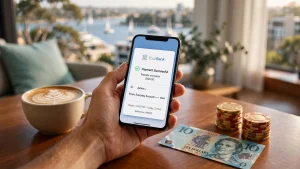
An explanation of how no-deposit spins work, which terms can apply, and why displayed winnings may not be immediately withdrawable.

The phrase “200 free spins” describes a quantity of spins attached to an offer; it does not describe a cash amount. A specialist review characterises a no-deposit bonus as casino funds or free spins made available without an initial deposit. That describes the offer’s basic structure, not a promise that you will receive money you can withdraw.
The distinction matters. A spin is an opportunity to play, and any result depends on what happens during play. Even if a balance displays a win, that display alone does not establish that the amount is cash, that it can be withdrawn, or that it has no conditions attached. The headline number tells you how many spins are being advertised. It does not tell you what those spins may return.
A useful way to read the headline is to separate its parts:
If you’re looking for 200 free spins with no deposit in Australia, check the offer’s current terms and eligibility before signing up. This list gives you a brief operator profile, but the details provided here do not confirm a specific free-spins offer.
Uptown Pokies
Uptown Pokies has operated since 2017 under a Curaçao licence, with a A$20 minimum deposit. The provided details do not confirm a 200-free-spins no-deposit offer.
Vegaz Casino
Vegaz Casino lists Curaçao licence OGL/2024/1335/0780 and a EUR 20 minimum deposit. You’ll need to check its current terms to confirm whether the page’s no-deposit offer is available.
Roby Casino
Roby Casino is identified as operating under Curaçao eGaming through Roby Games Ltd. No deposit or bonus details are provided, so the stated attributes do not establish a 200-free-spins offer.
Lucky Dreams
Lucky Dreams lists a Curaçao licence and a A$20 minimum deposit via POLi. The provided details do not specify a free-spins promotion.
Thor Casino
Thor Casino lists a Curaçao licence held through Antillephone N.V. for Versus Odds B.V., and a EUR 20 minimum deposit. Check the offer terms directly, as no no-deposit bonus details are provided here.
LevelUp Casino
LevelUp Casino lists Curaçao eGaming licence OGL/2023/174/0082 through Dama N.V. and a A$15 minimum deposit. The supplied information does not confirm a 200-free-spins no-deposit promotion.
SpinsUp
SpinsUp lists Curaçao Gaming Control Board licence OGL/2023/174/0082 through Dama N.V. No deposit or promotion details are included, so you’ll need to verify the offer separately.
DragonSlots Casino
DragonSlots Casino is identified as licensed by the Curaçao Gaming Authority through Jumpman Gaming Ltd. The provided details do not state whether a no-deposit free-spins offer is available.
Rollero Casino
Rollero Casino lists Curaçao Gaming Control Board licence OGL/2023/176/0095 through Hollycorn N.V. No deposit or bonus terms are supplied to confirm the page’s offer.
GoldenCrown
GoldenCrown lists Curaçao Gaming Control Board licence OGL/2023/176/0095 through Hollycorn N.V. The supplied information does not confirm a 200-free-spins no-deposit promotion.
That last distinction is where a generous-sounding figure can be easy to misread. A no-deposit offer removes one particular step: paying in before the stated bonus is provided. It does not, by itself, remove conditions on what happens after a spin produces a win. The bonus and any resulting winnings remain governed by the offer’s terms.
A specialist review gives a broad range of 25x to 70x for playthrough attached to no-deposit bonuses. For free-spin winnings, specialist reviews describe a range of 40x to 60x. These are reported ranges, not a rule that applies to every offer. They also should not be read as though the advertised spin count were itself a cash balance. The relevant playthrough basis and calculation are set by the terms for the particular offer.
This changes how you compare two headlines. If one advertises a higher number of spins, that alone does not establish that it is more valuable. The meaningful comparison is between the stated spin count and the conditions attached to resulting winnings. If those conditions are unclear, the headline cannot settle the question. Bigger is only better by the criterion you care about—and the spin count is not the whole criterion.
A “200 free spins no deposit” description may therefore be understood as a claim about access to a set number of spins without an initial deposit, rather than a claim that you will receive a particular sum. It does not promise a return, a withdrawable balance or a cash prize. Nor does the word “free” make the terms irrelevant. It identifies the initial price of the spins, not the status of any later winnings.
The label also cannot establish that a particular offer is available to people in Australia or that it may lawfully be provided here. It is a description of a bonus format, not evidence of local availability. That distinction is important when reading any page that presents an offshore casino offer to Australian residents: promotional wording should not be confused with permission to provide the service.
For a clear reading, treat the spin count as one entry in a comparison, not as the final verdict. Ask what the offer means by “no deposit,” what conditions apply to winnings, and whether those conditions make sense for your intended use. If the headline provides only a number, it has not answered the important money question.
The short version: spins are not cash. A win is not automatically a withdrawal.
A headline promising free spins on sign-up does not tell you how they reach an account. The activation method is a separate condition: the offer may be added automatically, may depend on a bonus code, or may be available only after registration steps are completed. A specialist review describes these as distinct ways a no-deposit bonus can be claimed; the wording of the headline alone does not establish which one applies.
Attention: Do not assume spins will appear instantly upon opening a page; activation may depend on specific routes such as bonus codes or completed registration steps.
Treat the process as a sequence to verify, not as a promise that spins will appear as soon as you open a page. First, identify the stated activation route. Then check whether the offer requires a new account, any account details to be confirmed, or a code to be entered during registration or later in the cashier. If the terms are unclear about when an action must happen, do not assume it can be completed afterwards.
With automatic crediting, the offer is meant to be attached to the account without a separate code entry. That does not necessarily mean the spins appear at the instant you submit a registration form. A specialist review notes that an operator may require account registration and verification checks before crediting them.
The useful distinction is between “automatic” and “instant.” Automatic describes the route by which the offer is assigned; it does not, by itself, settle whether checks come first. Look for a confirmation in the account or a clear statement that the offer has been applied. If nothing appears, avoid making assumptions based on the promotional headline. The account status and the stated terms are more useful evidence than the banner.
Other offers require a bonus code. The code may be entered in a field during sign-up, or the cashier may provide a place to enter it after registration. Those are different stages, and a code intended for one stage may not be accepted at another. A specialist review describes both registration and cashier entry as possible routes, so the wording for the particular offer matters.
Before submitting a form, check whether a code field is present and whether the offer’s instructions say to use it there. If the instructions direct you to the cashier, do not assume that entering the code in a registration field is equivalent. Keep the offer terms available while completing the steps, and check for an on-screen confirmation that the code has been recognised. A field accepting text is not proof that the benefit was attached.
The consequence of a missed or mistimed entry can be more than a delayed credit: a specialist review warns that an incorrect code, or one entered at the wrong point, could mean losing the benefit altogether. That is why the activation route deserves attention before you proceed, not after you expect the spins to be in your balance.
Registration can be part of claiming the offer, but the details requested should not be treated as a formality. The same specialist-review account says verification checks may be required before spins are credited. Where the terms make verification a condition, an incomplete account may remain ineligible for credit even if the registration itself has gone through.
Read the instructions in order: account creation, any verification step, then the stated method for applying the offer. If the order is not clear, pause rather than trying several routes at random. Repeated code entries or assuming the offer has been claimed can leave you with an account but no confirmed bonus.
A compact checklist helps keep the steps separate:
The deciding criterion is confirmation, not the wording of a promotion. If the stated steps do not produce a visible credit or status, the offer should not be treated as successfully claimed. That is a small administrative detail with a very practical result.
A headline promising 200 free spins without a deposit can sound like a straightforward promotion. In Australia, the more important question is where the offer comes from and whether the service behind it is lawful to provide to people in the country. The phrase “no deposit” describes a promotion’s payment condition; it does not make an online casino offer lawful or give it local protections.
The Interactive Gambling Act 2001 prohibits operators from supplying real-money online casino games to people located in Australia. That covers casino-style games such as slots, poker and table games. The legal restriction is directed at the service providers, not framed as a general criminal offence for a person who plays. The distinction matters: a lack of criminal liability for an individual does not mean the service is authorised in Australia.
Offshore offers sit outside Australia’s local consumer-protection framework. If a dispute arises over an account, a bonus or access to funds, you cannot assume that Australian casino rules or local complaint pathways will resolve it. The operator may be based overseas, and the terms may be governed by arrangements beyond the practical reach of Australian consumer bodies. That leaves a meaningful gap between a promotional claim and a remedy you can enforce locally.
This is not the same as saying every offshore site is readily available. Australian authorities actively block prohibited gambling services, and access can be disrupted. A page or offer that appears online is not proof that its operator may lawfully provide casino gambling to Australians, nor that access will continue. Availability and legal status are separate questions.
An offer’s advertised value cannot answer the questions that matter under this framework. A large spin count says nothing by itself about whether the operator is permitted to serve Australian residents, what protections apply if the account is restricted, or how a disagreement would be handled. The promotion and the legal position are separate columns in the comparison.
This is especially relevant when an offer is described as being for Australia. That wording may identify an intended audience, but it does not create Australian authorisation. Nor does a foreign licence substitute for permission to provide prohibited online casino services to people in Australia. A licence issued elsewhere and the Australian legal position are not interchangeable.
Individual players are generally not the target of the Act’s prohibition on providing casino services. In most states, taking part at an offshore casino is not treated as a criminal offence for the player. But that limited point should not be mistaken for endorsement, a guarantee of access, or a promise of help if the operator fails to honour its own terms. The practical protection available to you can be weaker precisely because the service is offshore.
Legal Status
The Interactive Gambling Act 2001 prohibits operators from supplying real-money online casino games to people located in Australia.
So when you assess a no-deposit offer, separate three issues: what the promotion claims, whether the operator can lawfully provide the service to Australians, and what recourse exists if something goes wrong. The first may be displayed prominently. The other two are not solved by the words “free spins” or “no deposit.”
That is the legal context, not a recommendation to sign up. In Australia, the central comparison is not simply which offer has the larger headline number. It is whether the service is lawful to provide locally and whether you would have meaningful local protection if a dispute arose. A bonus cannot answer either question. The headline is the easy part.
A headline promising 200 free spins does not mean you can apply them to any game in a casino’s catalogue. The game restriction is part of the offer: spins may be assigned to one named game or a small selection. If you had a different slot in mind, the advertised number alone will not tell you whether it qualifies.
The decisive detail is the eligible-game wording in the offer’s terms. Look for the game title or titles, and check whether the restriction applies to every spin or only to a particular part of the promotion. A reference to free spins without a clear eligible-game description leaves an important practical point unresolved. The number can look generous on a banner; the permitted choice may be narrow.
A 200-spin headline is meaningful only alongside its conditions. If the terms name one game, treat the spins as specific to that game rather than as a balance you can move elsewhere. If they name a limited selection, confirm that the game you expect to use is actually included. Similar titles are not necessarily interchangeable.
This is also why the phrase “200 free spins at casinos” does not describe one standard arrangement. The number does not establish which games are eligible, whether you can choose among them, or whether the offer is available under the same terms in every case. Those details belong to the individual offer, not to the headline.
Do not infer eligibility from a game’s appearance in a general catalogue or from a search result. The promotion’s own terms are the relevant comparison point. If the named game is absent from the eligible list, or the list is unclear, the headline does not settle the question.
Game eligibility is only one part of the restriction. A specialist review describing these offers reports that a pre-selected game may come with a minimum stake of 10 or 20 cents. That is a reported example, not a universal rule: the amount applicable to a particular offer needs to be stated in its terms.
Check whether the stake condition is expressed per spin and whether the listed game has to be selected before the spins become usable. Do not assume that a lower stake, a different game, or a change made after crediting will be accepted. If the terms do not explain how the restriction works, the headline is not enough to resolve it.
More spins do not automatically mean more choice, as eligibility depends on the specific games and minimum stakes defined in the offer's terms.
The comparison is straightforward: one offer may give you a named game with a stated minimum stake; another may have a different eligible game or no clearly stated detail in the headline. The better fit depends on whether the permitted game and stake suit the conditions you are willing to accept. More spins do not automatically mean more choice.
Time limits can narrow the offer further. A specialist review reports that some no-deposit offers remove unused spins after 24 hours. That is a reported condition for some offers, not a deadline that can be assumed to apply to all of them. Check the stated expiry point and what event starts the clock.
A restriction on game choice answers *where* spins can be used; an expiry condition answers *how long* they remain available. Keep both in view. A named game does not tell you the time limit, and a stated time limit does not tell you which game qualifies.
For an Australian reader, this is a description of how promotional terms can be written, not a recommendation to access an online casino. The practical reading test is narrow: identify the eligible game, note any minimum stake, and confirm the stated expiry. If any of those points is missing or ambiguous, the spin count alone gives an incomplete picture.
A phone does not remove the account checks attached to a promotion. A specialist review describes registration and verification as possible steps before free spins are credited. That distinction matters: seeing an offer while browsing on a phone is not the same as having spins added to an account, and creating an account does not necessarily mean every check is complete.
Keep the stages separate. Registration creates the account; verification is a further check that may be required before the promotion is credited. The exact process depends on the operator’s terms. Read those terms before entering personal information, and look for wording that says what must be completed before the spins become available. If the condition is unclear, do not assume that using a smaller screen changes it.
A phone can make it tempting to move quickly through signup fields. Resist that urge. Check the information you enter before submitting it, and pause if a request or condition is unclear. This is not a claim about a special mobile process: the relevant issue is the account, not the device. Whether you start on a phone or elsewhere, the same stated registration and verification conditions may stand between signup and receiving the promotion.
Verification timing can also affect what happens later. A specialist review notes that completing identity verification before winning can help avoid payout delays. That does not guarantee a faster payment, and it does not remove any other conditions. It does give you a practical reason to understand the verification process before treating a displayed balance as money you can access.
Use a simple comparison when reading the terms:
| Check | What to establish |
|---|---|
| Registration | Whether an account must be created before the promotion can be credited |
| Verification | Whether checks are required before the spins are added |
| Timing | Whether completing verification earlier may help prevent a later payout delay |
The phone itself is not the deciding criterion. The useful comparison is between an offer with clearly stated account steps and one whose conditions leave you uncertain. If the terms do not explain what verification involves or when it must be completed, do not fill the gap with assumptions. A promotion labelled “200 free spins” says nothing by itself about whether your account has passed the checks needed to receive them.
Be cautious about treating a promotional message, signup screen or account display as confirmation that every step is finished. A pending check may still affect whether spins are credited or whether a later payout is delayed. Read the operator’s conditions in full, keep track of any status shown in your account, and avoid submitting information if you cannot tell who is requesting it or why. A phone makes the screen smaller. It does not make the terms smaller.
A balance shown after free spins is not necessarily money you can withdraw. It may still be subject to playthrough, account checks or a deposit condition. Treat the displayed amount as provisional until the offer terms say what must happen before a withdrawal can be requested.
Attention: A displayed balance is not a payout; it may be subject to playthrough requirements, account checks, or minimum deposit conditions before it becomes withdrawable.
A specialist review reports a condition in which free-spin winnings must be wagered 30 times before they become withdrawable. That figure belongs to the terms it describes, not to every offer. Check how the operator defines the amount used for the calculation: the winnings, the bonus value or another stated base. If the terms are unclear, you cannot reliably estimate the play required from the balance alone.
Clearing playthrough can also change the cost of claiming an apparent win. A specialist review warns that players attempting to meet the requirement may end up spending real money they had not planned to spend. The key comparison is not simply the displayed balance against the required play; it is whether continuing to play makes sense for you, given that the balance may never become cash. Stop rather than treating extra spending as a guaranteed route to withdrawal. A screen balance is not a payout.
Verification is another step to account for. A specialist review says casino identity checks are generally required before withdrawals, including when the winnings began with a no-deposit bonus. Completing verification before requesting a payout may help avoid delay, but it does not remove other conditions. The operator’s terms determine what checks apply and when they must be completed.
Some casinos also make a minimum deposit a condition of withdrawing no-deposit bonus winnings. That means “no deposit” can describe how the offer is received, not necessarily every step between claiming it and cashing out. Before you spend time—or money—trying to convert the balance, check whether a deposit is required, whether it is refundable, and whether it creates any further playthrough. Do not assume the deposit is a formality.
A useful way to assess a real-money offer is to separate its stages: the win appears, playthrough is completed, verification is accepted, and any deposit condition is met. The terms should make clear which stages apply and what counts as completion. If they do not, the amount shown in your account cannot tell you what you will be able to withdraw.
For Australian readers, these mechanics do not change the legal status of online casino services: operators are prohibited from providing real-money online casino games to people in Australia. A withdrawal condition is not a safeguard or a guarantee of access to funds.
A headline count tells you how many spins are offered, not how much of any resulting win can be withdrawn. The same distinction applies to a free chip: its face value is not necessarily cash you can take out. To compare the two, separate the playthrough from the cashout cap. They answer different questions.
For free-spin winnings, specialist reviews have reported playthrough figures in the 40x to 60x range. That is a reported range, not a term you should assume applies to every offer. If an offer sets a playthrough, check what amount it applies to and whether the winnings must meet that condition before a withdrawal can be requested.
Free chips can use a different calculation. Specialist reviews have described requirements of 30x or 40x the chip amount. With a $50 chip and a 30x requirement, the calculation is $50 multiplied by 30, or $1,500 in total bets. That figure is the required betting volume, not a promised loss, a balance, or a withdrawal amount. The distinction matters: a large number of spins or a chip that looks substantial can still come with a demanding route to cash.
Caps add another limit. Specialist reviews have described no-deposit cashout caps from $10 to $100, while other reported terms place a cap as high as A$1,000. Those figures should not be combined into a single market rule; they show why the specific offer’s terms matter. A cap sets the maximum that can be paid out under the promotion, even if the displayed balance is higher. A playthrough condition, meanwhile, determines what must be wagered first. A generous cap does not remove the playthrough, and a lower playthrough does not raise the cap.
| Term | What it controls |
|---|---|
| Playthrough | The amount of betting required before eligible winnings can be withdrawn |
| Cashout cap | The maximum amount payable under the offer |
For a 200-spin promotion, the useful comparison is not just the spin count. Look for the playthrough attached to the winnings and the maximum cashout, then judge those terms together. If the offer gives a free chip instead, calculate the required betting volume from the chip amount and its stated multiple. The better offer depends on your criterion: more spins may matter to one reader, while a lower hurdle or a higher cap matters more to another. The headline is only the first row in the comparison.
A promo code is not simply a label attached to an offer. It can be the step that links your registration to the stated benefit. A specialist review describes several possible claiming routes: registering, entering a code, or receiving a bonus automatically at sign-up. Which route applies depends on the offer’s terms; a code field appearing on a form does not by itself confirm that a particular code is valid.
Using the wrong promo code or entering the correct one at the wrong stage can result in losing the bonus benefit altogether.
If a code is required, treat its entry as a condition, not a detail to fix later. A specialist review warns that using the wrong code—or entering the right one at the wrong stage—can mean missing the benefit altogether. That makes the timing as important as the characters. Before submitting registration or moving on from the cashier, check the offer instructions and confirm that the code has been accepted, if the process provides confirmation.
The same care applies when an offer is described as 200 free spins. The headline does not establish that a code is needed, that one will work for every account, or that a missed entry can be corrected afterwards. Those points belong to the specific terms. If the offer is credited automatically, adding an unrelated code may not help; if a code is mandatory, leaving the field blank may prevent the claim.
Keep a record of the code and the instructions shown when you attempt to use it. If the benefit does not appear, contact the operator before assuming that the issue can be resolved after play begins. A small field, a firm consequence.
A Bitcoin reference and a no-deposit bonus describe different parts of an offer. Bitcoin concerns a payment method; “no deposit” describes a condition for receiving a bonus. Neither phrase, by itself, confirms that a particular promotion accepts Bitcoin or that its terms are tailored to cryptocurrency users.
A specialist review describes a no-deposit bonus as casino funds or free spins provided without an initial deposit. That is a description of the format, not evidence that any specific offer is available to Australian residents, accepts Bitcoin, or grants 200 spins. Treat those details as separate questions, each requiring explicit terms.
For a Bitcoin-related promotion, the terms would need to state whether Bitcoin is accepted, whether it applies to claiming the bonus, and what happens to any resulting winnings. A headline alone cannot answer those points. Nor does a large spin count tell you how the bonus is funded or what currency a casino account uses. Labels are not terms.
The distinction matters because “Bitcoin casino” can sound like a complete description when it is only a reference to one possible payment method. A no-deposit label does not prove that you can claim an offer without first meeting other stated conditions, and a mention of free spins does not establish that those spins are available for a particular game or account.
Read the actual promotion wording rather than inferring details from a Bitcoin reference or a headline promising 200 free spins. If the terms do not clearly connect the payment method and bonus, do not assume they are connected. That is the useful limit: the general no-deposit concept can be described, but Bitcoin-specific eligibility must be stated in the offer itself.
“No deposit” describes how an offer may be claimed, not whether any resulting winnings are immediately available to withdraw. A specialist review describes this kind of bonus as providing casino funds or free spins without an initial deposit. That does not remove the conditions attached to converting a win into cash.
For free-spin winnings, the key distinction is between a balance displayed in an account and money that has cleared the required playthrough. The winnings must be wagered before withdrawal, and the stated time limit is five days. If you are assessing a headline for 200 free spins, check whether that period starts when the spins are credited or at another point in the offer terms; the headline alone does not settle the question.
Missing the deadline can matter even if the spins were described as free. Read the terms for the exact start and end of the playthrough period, and avoid treating a displayed balance as withdrawable until the requirement is complete. “No deposit” removes an initial payment condition; it does not erase the rules on claiming or converting winnings.
That is the practical test for any offer described as a casino with no-deposit free spins: separate the cost of claiming from the conditions on winnings. The phrase tells you only the first part. The playthrough deadline still counts.
No, a no-deposit offer does not require an initial deposit. Some casinos may require a deposit before allowing you to withdraw winnings.
Register and follow the offer’s activation instructions: spins may be credited automatically, or you may need to enter a bonus code during sign-up or in the cashier. Account verification may also be required before the spins are credited.
Yes, but you generally need to meet the wagering requirements first and complete identity verification. Some offers also require a deposit before withdrawal or limit the amount you can cash out.