POLi availability can depend on the specific transaction and customer, so general payment listings are not conclusive.
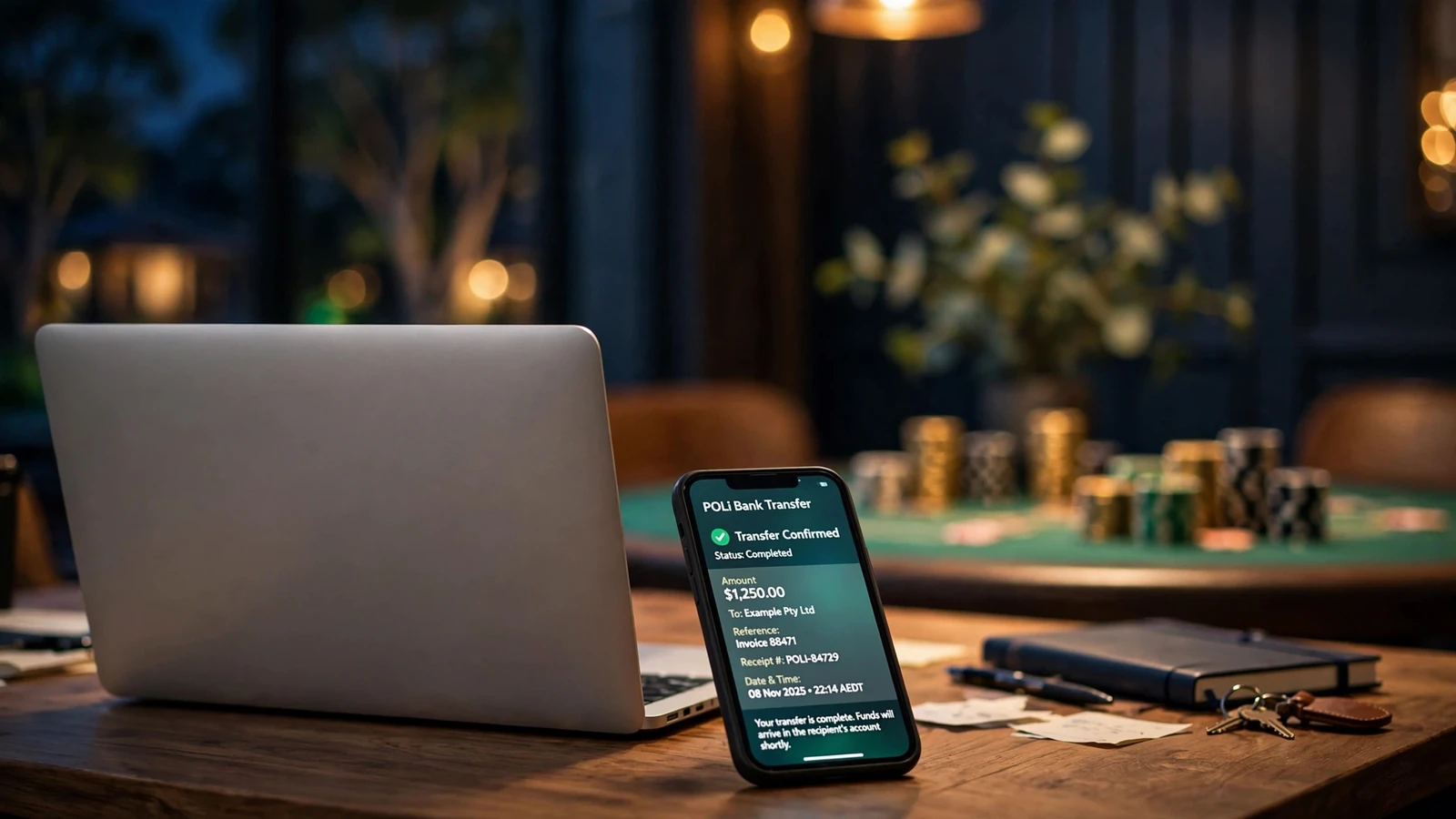
Whether an online casino accepts POLi for Australian customers is a specific, changeable question. It cannot be answered reliably by a general claim that a site offers bank-linked payments, by an old description of its cashier, or by a page that simply groups POLi with other deposit methods. The relevant point is whether the operator currently makes POLi available for the transaction and customer in question.
That distinction matters because “accepts POLi” can sound more definite than the evidence behind it. A payment logo, a mention in a broad list of methods, or a statement about Australian banking does not by itself establish that POLi appears as an option in a particular casino’s cashier. Nor does it show that the option is available to every customer or account. Those are separate details, and they need specific confirmation.
The same standard applies to searches for Australian online casinos or pokies that take POLi. The wording may suggest there is a settled list of suitable sites, but a list is only as dependable as its underlying evidence. Without current, operator-specific confirmation, naming a casino as a POLi option would overstate what can be established. A polished table would not fix that gap. It would only make the uncertainty look organised.
If you’re looking for a casino that accepts POLi in Australia, the details below can help you check the available information before choosing. A listed payment method or deposit amount is not a guarantee that POLi is currently available to you.
Uptown Pokies
Uptown Pokies has operated since 2017 under a Curacao licence. Its minimum deposit is A$20.
Vegaz Casino
Vegaz Casino holds Curacao licence OGL/2024/1335/0780. Its minimum deposit is EUR 20.
Roby Casino
Roby Casino is licensed by Curacao eGaming through Roby Games Ltd. This licensing detail is the available point of reference for you.
Lucky Dreams
Lucky Dreams lists a minimum deposit of A$20 via POLi, making it the entry here with a stated POLi deposit option. It is licensed in Curacao.
Thor Casino
Thor Casino is licensed in Curacao by Antillephone N.V., with Versus Odds B.V. named in its licensing details. Its minimum deposit is EUR 20.
LevelUp Casino
LevelUp Casino holds Curacao eGaming licence OGL/2023/174/0082, with Dama N.V. named as the operator. Its minimum deposit is A$15.
SpinsUp
SpinsUp is listed with Curacao Gaming Control Board licence OGL/2023/174/0082, associated with Dama N.V. This licensing detail is the available point of reference for you.
DragonSlots Casino
DragonSlots Casino is listed under the Curacao Gaming Authority, with Jumpman Gaming Ltd named in its licensing details. This is the available reference information for you.
Rollero Casino
Rollero Casino is listed with Curacao Gaming Control Board licence OGL/2023/176/0095, associated with Hollycorn N.V. Its licensing details are the available reference point here.
GoldenCrown
GoldenCrown is listed with Curacao Gaming Control Board licence OGL/2023/176/0095, associated with Hollycorn N.V. This licensing detail is the available point of reference for you.
For a claim to be useful, it should identify the operator, the relevant customer market, and the payment action being described. It should also be clear whether the information comes from the operator’s own current terms or cashier, rather than an undated summary or a third-party description. If those elements are absent, the claim may be incomplete even if POLi is mentioned somewhere on the page.
This is particularly important when a description uses broad wording such as “bank transfer,” “online banking,” or “local payments.” Such categories are not interchangeable with a named payment method. A reader cannot safely infer that POLi is supported just because a page refers to bank-linked services. The method needs to be identified directly, and the relevant availability needs to be clear.
A mobile-friendly page does not settle the question either. The fact that a cashier can be opened on a phone would not, on its own, establish that POLi is among its available options. “Mobile casino” describes how a service is accessed; it is not confirmation of a payment method. Keeping those questions separate avoids turning a general description of a website into a specific payment claim.
The word “best” also requires a criterion. A site cannot be called best for POLi access merely because it has a polished design, a broad payment menu, or a prominent Australian-facing page. For that judgement, verified POLi availability would be a necessary comparison point. If that point is unconfirmed, ranking operators by POLi suitability has no sound basis. A label is not a comparison.
There is a wider Australian context to keep in view. The Interactive Gambling Act 2001 prohibits operators from offering real-money online casino games to people in Australia, and the Australian Communications and Media Authority enforces that law. This legal position concerns the provision of the games; it does not prove that any operator supports POLi. Payment information and legal status answer different questions.
So the narrow answer is also the most accurate one: a claim that a casino accepts POLi should rest on current, specific confirmation, not on inference from a general payment description. If that confirmation is not available, the acceptance claim remains unsubstantiated. No operator should be presented as a verified POLi choice on that basis alone.
That is a limited answer, but it is more useful than a confident list built on assumptions. For Australian readers, “POLi mentioned” and “POLi confirmed for this operator and transaction” are not equivalent. The distinction is simple. The evidence must do the work.
A deposit decision depends on more than whether a payment name appears somewhere on a casino website. If you are checking whether POLi can be used for a deposit, treat the cashier as the point where the relevant transaction details must be clear. A general payment-method page, an old review, or a logo elsewhere on a site does not by itself establish that POLi is available for your account and intended deposit.
Before proceeding, look for POLi as an actual selection in the deposit flow. Check that the option is presented for the account and currency you intend to use, and that the amount you enter is shown clearly before you authorise anything. If POLi is not displayed as a selectable method, do not infer that it will become available later or that another bank-linked option is equivalent. Similar names do not establish the same payment route.
Read the information shown before submitting a payment. The useful details are the method selected, the currency, the amount to be charged, and any fee or exchange-rate information disclosed at that stage. If a fee is not shown clearly, do not assume that the deposit is free. If the amount appears in a currency other than Australian dollars, check how the conversion is handled before confirming.
The minimum deposit matters only if it is stated for the specific method and account in front of you. A figure in an older article or a general cashier description may not apply to the transaction you are considering. Do not rely on a particular low deposit threshold unless the current deposit screen explicitly accepts that amount. A requested amount and an accepted amount are not necessarily the same thing.
Processing time is another detail to verify, rather than guess. A payment method’s name does not establish whether a deposit will be credited immediately, delayed for review, or declined. Look for a clear explanation tied to the transaction. If the screen gives no timing information, avoid planning around an assumed arrival time.
Before submitting, also check whether the payment must come from an account in your own name, whether the operator applies account or transaction restrictions, and what happens if the payment is interrupted. These conditions can affect whether a deposit is accepted. Do not proceed on the basis of an informal description that leaves the relevant condition unclear.
The wording around a payment option can be ambiguous. “Bank payment,” for instance, does not necessarily mean POLi, and a mention of POLi in general help material does not necessarily mean it is available for the deposit you are about to make. Confirm the method in the live cashier and make sure the displayed instructions correspond to that method. If the cashier redirects you to a different route, pause and assess that route separately rather than treating it as a continuation of the same choice.
Keep a record of what the transaction screen states before you act. That can help you compare the amount and method shown with any later account entry or payment notice. It is not a substitute for clear terms, and it does not guarantee that a transaction will succeed. It simply gives you a concrete reference instead of relying on memory.
A small deposit does not remove the need to check these details. The amount alone cannot tell you whether POLi is available, whether a fee applies, or when funds will appear. If you are considering a low-value test, confirm first that the amount is permitted and that the payment route is explicitly POLi. There is no sound basis for assuming that a particular amount, including a commonly searched figure, will work across different cashiers.
Do not submit a payment if the amount, currency, method, or applicable charge is unclear. Do not try a different payment route simply because the intended one is absent, unless you have separately checked what that alternative involves. If the cashier’s instructions conflict with the site’s general payment information, seek clarification before acting. A deposit screen should let you identify what you are authorising; uncertainty is a reason to stop, not a detail to fill in yourself.
There is also an important Australian consumer-protection issue. Consumer law does not protect players who use offshore casinos. That matters when deciding whether to send money: a payment method’s presence does not provide the protections associated with a locally authorised casino service. The payment question and the legal status of the service are separate, but neither should be overlooked.
For a deposit, the practical standard is straightforward: confirm the exact method in the cashier, read the transaction terms, and proceed only if the amount and conditions are intelligible. POLi should not be inferred from a broad payment label, a remembered offer, or a low-deposit claim. If the relevant details are not clear before submission, leave the transaction unmade.
A ranking of casino sites is useful only when the sites are being judged against the same criteria. For a POLi-focused comparison, the first criterion would be confirmed acceptance of POLi for the relevant transaction. The others would need to be checked consistently across every site being compared. Without that foundation, calling one option “best” gives a firm answer to a question the comparison has not actually tested.
That applies whether you are looking for a POLi casino, a site that takes POLi deposits, or an option described as suitable for pokies. Repeating those labels does not establish that a payment method is available, and it does not make sites comparable. A name in a list is not proof of current acceptance.
Start with a defined set of criteria, then apply each one to every candidate. For a payment-method comparison, the central test is whether POLi is explicitly available to the relevant customer for the transaction being considered. A general reference to bank payments, or to a cashier offering several methods, would not answer that question by itself.
The comparison would also need consistent, current information about each site. If one entry is assessed using a current cashier and another relies on an old description, the results are not on equal terms. A table can make the difference visible: list the same criteria in the same order, record what is confirmed, and mark anything that cannot be established as unverified rather than treating it as a match.
That is a useful standard, not a recommendation to use any particular site. A carefully formatted table can still be misleading if its entries rest on different kinds of information. Structure helps only when the underlying comparisons are sound.
There is no single winner unless “best” has a precise meaning. A site might rank well on one stated measure and poorly on another; a POLi-specific comparison would first need verified acceptance, then a clear reason for comparing the remaining features. If the measure changes from one entry to the next, the ranking stops being a ranking and becomes a collection of unrelated claims.
The same point applies to requests for the best POLi casino site or the best site for POLi deposits. Those phrases suggest that a tested set of options exists and that each option has been measured in the same way. Without that, a numbered list creates an appearance of certainty without showing what the numbers mean. No useful winner emerges from a label alone.
A comparison should also distinguish payment availability from access to games. In Australia, the Interactive Gambling Act 2001 prohibits operators from providing real-money online casino games to people physically in the country. A payment method does not change that restriction. This is a material limit on what any Australia-facing casino comparison can responsibly imply.
When you encounter a list, check whether it explains its criteria and whether the same standard is applied to every entry. Look for a direct statement about POLi rather than an inference from a general payment category. Check whether the information is current, and whether the ranking separates confirmed details from assumptions. If those distinctions are absent, the list cannot establish which option performs better on POLi acceptance.
Be cautious with rankings that attach “instant” to a payment claim without specifying what transaction they mean. A deposit and a withdrawal are different claims; evidence for one does not establish the other. The phrase itself is not a comparison criterion unless every entry is assessed against the same transaction and the same timing measure.
For Australian readers, there is a further boundary: Australian consumer law does not protect players who use offshore casinos. That makes a polished ranking no substitute for clear, verifiable information, and it should not be mistaken for an endorsement or a safeguard.
The sound conclusion is narrow. A meaningful POLi comparison needs confirmed acceptance and like-for-like site information. Where those conditions are not demonstrated, there is no defensible basis for ranking casino sites by POLi suitability. A tidy table cannot repair an uneven comparison.
“Instant withdrawal” can describe different stages of a payout. It might refer to an operator approving a request, sending funds, or the funds reaching an account. Those are not the same event. A short processing label does not, by itself, tell you when money becomes available to you.
POLi acceptance for a payment does not establish that POLi can also be used to receive winnings. Deposits and withdrawals are separate transaction types, and a payment option shown for one does not automatically apply to the other. Nor does the word “instant” establish that a payout through POLi is available or fast.
A useful way to assess a payout claim is to separate three questions:
| Payout question | What the wording needs to clarify |
|---|---|
| Is POLi offered for withdrawals? | Whether it is explicitly listed as a payout method, rather than only as a deposit option |
| What does “instant” describe? | Whether it means approval, dispatch, or receipt of funds |
| What conditions apply? | Whether the stated process depends on account status or other operator requirements |
If a payment page mentions POLi only in connection with adding funds, that wording should not be read as a promise about withdrawals. If a page says “instant payouts” without identifying the method or the stage being measured, the phrase leaves the practical question unanswered. Marketing language is not a timetable.
The same distinction applies to claims about real-money payouts generally. A method’s name on a cashier page is not enough to establish that every transaction can use it in both directions. The operator’s withdrawal terms would need to state the available route and explain what its speed claim covers. Without those details, there is no sound basis for comparing POLi with another withdrawal method on speed.
“Best” also depends on the criterion. If your criterion is receiving funds through POLi, the key issue is explicit withdrawal support. If it is speed, the relevant detail is how long each stage takes and what “instant” means in that operator’s wording. If neither point is clear, a ranking would create confidence without a measurable comparison.
Attention: A deposit offer or registration message cannot establish that POLi is a withdrawal option or make an unclear speed claim precise.
No deposit offer changes that test. A promotion or a registration message cannot establish that POLi is a withdrawal option, and it cannot make an unclear speed claim precise. Keep the payout question separate from any claim about deposits or bonuses.
For Australian readers, there is a further boundary: real-money online casino games are prohibited for operators serving people in Australia under the Interactive Gambling Act 2001. Information about payment terminology should not be mistaken for an endorsement or recommendation to use an offshore casino. Consumer law does not protect players using offshore casinos.
The practical reading is narrow: treat “instant POLi withdrawal” as a claim that needs clear, transaction-specific terms, not as proof of a particular payout route or arrival time. Without that clarity, the speed cannot be judged. “Instant” is not a clock.
A casino “accepts POLi” only if POLi is available for the transaction you mean to make. A payment logo, a reference to bank payments or a general list of cashier options does not establish that. The distinction is practical: a site might mention a payment category without showing that POLi itself is available to a particular customer or for a particular transaction.
Treat acceptance as a specific claim, not a broad description. The relevant question is not whether a site has some connection to bank payments, but whether POLi is explicitly identified as an available method in the relevant part of its cashier. “Bank transfer” and “POLi” are not interchangeable labels. Nor does POLi support for one transaction establish support for another.
That is the criterion that matters when someone asks which casino takes POLi: confirmed availability for the intended use. A list of sites cannot answer that reliably unless each entry is based on clear, current confirmation. Without it, calling any casino the best option because it “has POLi” would confuse an unverified label with a usable payment method. The winner depends on what you need, and the method must first be shown to be available.
Look for POLi to be named directly in the cashier or in the operator’s current payment information. The wording should make clear which transaction it applies to. If the information only refers to bank payments, online banking or a range of payment options, it does not settle whether POLi is included.
The same standard applies to phrases such as “POLi casino” or “casino with POLi pay.” They may describe an operator’s payment offering, but the phrase alone does not show what is available to you. A reference on an old page, a search listing or a third-party summary can also differ from the options presented by the operator. Clear confirmation matters more than a familiar label.
Do not treat a method as supported merely because it appears in a general payment overview. Check that the exact method is named for the transaction in question. If the wording is unclear, the answer is unclear; substituting a nearby payment category does not resolve it.
Acceptance is not a general endorsement of a site, and it does not establish that every customer will see the same option. It also says nothing by itself about other payment features, terms or the legality of the service. Those are separate questions and should not be inferred from a POLi label.
For a careful comparison, record only what the wording actually confirms: POLi named, transaction specified, and information current. If any part cannot be established, mark it as unconfirmed rather than treating it as a match. That is less dramatic than a “best” label. It is also more useful.
A payment method and the service it might be used to pay for are different questions. Seeing POLi listed as a payment option would not establish that an operator may lawfully offer online casino games to people in Australia. Likewise, the legal status of a game service does not tell you whether POLi is available for a transaction.
For Australian residents, the key legal distinction is at the operator level. The Interactive Gambling Act 2001 prohibits operators from providing online casino games to people in Australia. The Australian Communications and Media Authority (ACMA) oversees enforcement of that law. A cashier label cannot alter that rule.
| Question | What it establishes |
|---|---|
| Is POLi presented as a payment option? | A payment-method claim, if confirmed for the relevant service and transaction |
| Is an online casino game offered to people in Australia? | A separate question governed by the Interactive Gambling Act 2001 |
| Does a POLi option make the game service lawful? | No; payment availability does not change the operator’s legal obligations |
The table is the useful comparison: payment acceptance concerns how a transaction might be made; the Act concerns whether an operator may offer the underlying online casino service to Australians. Treating those as interchangeable can make a payment logo seem like a legal assurance. It is not.
This also means that descriptions such as “POLi casino games” can blur two separate claims. One is that a payment service is available; the other is that an operator offers games to Australian residents. Evidence for the first would not prove the second, and neither should be inferred from a general list of payment options. A search for POLi casino payment options does not resolve the legal question.
The Act is directed at operators. It does not explicitly make players’ use of offshore sites a criminal offence. That distinction should not be mistaken for approval of an operator’s offer, or as proof that a particular service is accessible or permitted. The relevant point here is narrower: payment support and the legality of offering online casino games are not the same criterion.
Legal Warning
The Interactive Gambling Act 2001 prohibits operators from providing real-money online casino games to people in Australia.
For a reader assessing any claim involving POLi and casino games, keep the two columns separate: payment method on one side, lawful service provision on the other. Combining them produces a confident-looking answer to the wrong question. Separate issues.
A search for an Australian casino that accepts POLi can blur two separate issues: whether an operator offers that payment method and whether the operator may lawfully provide online casino games to people in Australia. A payment option does not change the legal status of the service. Nor does a site’s use of Australian-facing language establish that it is authorised to offer casino games here.
Under the Interactive Gambling Act 2001, operators must not provide real-money online casino games to people physically located in Australia. The Australian Communications and Media Authority (ACMA) enforces the Act. The restriction is directed at operators: it does not explicitly make a player’s use of an offshore casino a criminal offence. That distinction matters, but it is not a guarantee that an offshore service is accessible, dependable or subject to Australian oversight.
Australian consumer law does not protect players who use offshore casinos. If a dispute arises over an account, payment or withdrawal, you should not assume that the protections and remedies available in an Australian consumer transaction will apply. A website’s claims about its location, terms or payment methods do not, by themselves, give you local consumer protections.
The practical comparison is therefore not simply “POLi available” versus “POLi unavailable.” Even if a cashier displayed POLi, that would answer only a payment question; it would not establish that the casino may serve Australian residents or that you have local protection if something goes wrong. Equally, the fact that the law places the prohibition on operators does not turn offshore gambling into a protected consumer service.
Keep the boundaries clear: operator restrictions concern the provision of the service; the player’s legal position is distinct; and consumer protection is a separate question again. These points are easy to collapse into one reassuring label. They are not the same thing.
A POLi payment used to fund an account does not, by itself, establish that the same method can receive winnings. Deposit and withdrawal options are separate transaction rules. If you are assessing a claim about a POLi withdrawal, look for wording that specifically covers payouts to POLi, rather than a general statement that POLi is accepted.
The distinction matters because a cashier may show a method for adding funds without offering it for withdrawals. Payment availability can also depend on account conditions set by the operator. Treat “POLi accepted” as a description of a particular transaction only when the terms clearly identify that transaction as a withdrawal.
Identity checks are another separate step. Online casinos typically assess a customer’s identity before allowing financial transactions. This Know Your Customer process can make transaction readiness conditional on providing and having details checked. Completing an identity assessment, however, does not show that POLi is available for a payout, nor does it establish how quickly a withdrawal would be processed.
Keep three questions apart: has your identity been assessed, does the cashier permit POLi withdrawals, and what processing conditions apply to that specific payout? An answer to one does not settle the others. No shortcut there.
There is also an important Australian context. The Interactive Gambling Act 2001 prohibits operators from providing real-money online casino games to people in Australia, and the Australian Communications and Media Authority enforces the Act. Australian consumer law does not protect players who use offshore casinos. That risk is distinct from payment mechanics: a POLi option or an identity check does not change the legal position or provide consumer protection.
For a careful assessment, read the payment terms as transaction-specific rules, not as a blanket promise about all money moving through an account. A statement about deposits cannot establish withdrawal eligibility, and identity verification cannot establish payout speed. If a service does not state clearly whether a payout can go to POLi, do not treat a deposit option as proof that it can.
Australian payment habits are not tied to one channel. Contactless credit and debit cards are accepted almost everywhere, as are mobile wallets such as Google Pay and Apple Pay. Many consumers are also comfortable moving between cards, wallets and bank-linked services such as PayPal. Familiarity with several options gives you a practical basis for comparing payment methods, but it does not mean every merchant offers every method.
A useful comparison starts with the task. If you already carry a contactless card, it may be the simplest option where that card is accepted. A mobile wallet can suit you when you prefer to pay using a device rather than taking out a card. A bank-linked service may fit better when you want to use an account-based service you already know. The choice depends on what you value: familiarity, the way you prefer to access funds, or the payment options actually presented at checkout.
For online payments, keep general acceptance separate from merchant-specific availability. A method’s broad use across Australia says little by itself about whether a particular service supports it. That distinction matters when considering POLi: comfort with cards, wallets and PayPal is context about consumer habits, not evidence that a casino payment method is available. A familiar payment landscape is not a merchant’s cashier.
You can compare options without assuming that one is universally better. First identify the payment method you want to use; then consider whether the merchant offers it and whether its terms suit you. If the preferred option is not available, the alternative that works best depends on your own priorities. There is no single winner across every checkout.
This broader context also explains why Australians may switch between payment types rather than rely on just one. Cards and mobile wallets have wide acceptance, while bank-linked services are also familiar to consumers. Those are useful reference points for understanding payment preferences, not a guarantee about any specific online service. Verify the actual options before making a decision.
A bonus description and a payment method answer different questions. Seeing them mentioned together does not establish that POLi is available, that a POLi transaction qualifies for a promotion, or that any promotion is offered to Australian residents. A “POLi casino bonus” label is not confirmation of payment compatibility.
Keep the criteria separate. Payment information concerns whether a transaction can be made using POLi; promotion terms concern the conditions attached to an inducement. One cannot stand in for the other. Even where terms name a payment method, that wording should not be treated as proof that the method is currently available for a particular transaction.
For Australian readers, there is also a more important boundary: the Interactive Gambling Act 2001 prohibits operators from providing real-money online casino games to people in Australia. A bonus mention does not alter that restriction or make an offer lawful. The Australian Communications and Media Authority enforces the Act.
So, if you encounter wording that links POLi with a casino promotion, do not read the promotion as evidence that POLi is supported or that the offer is suitable for you. Nor does a bonus make an unverified payment method more reliable. The two claims need independent confirmation—and promotional language cannot supply it by implication.
Separate terms. No implied support.
Select American Express in the casino’s deposit cashier and check that it is available for your account and intended transaction. Confirm the currency, amount and any disclosed fees before submitting the payment.
Jackpot City Casino, Spin Palace, Ruby Fortune, Ignition Casino, Joe Fortune and PlayAmo are listed as supporting Amex deposits for Australian players. Check the casino’s current cashier to confirm it is available for your account.
Some casinos do not accept American Express, and Amex or your Australian bank may block gambling transactions to a particular website. Check whether Amex is selectable in the casino cashier and whether your card issuer permits the payment.
Some casinos do not allow withdrawals to American Express. Where they do, you generally need to have deposited with Amex first, and a withdrawal fee may apply.
Amex deposits typically have no fee, but a casino may apply a surcharge, and currency conversion can incur a fee. Check the amount and any charges shown in the cashier before confirming.
Limits are set by each casino and can vary. Check the deposit or withdrawal details in the cashier for the limits that apply to your account and transaction.