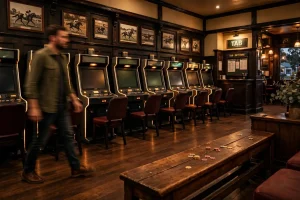
The term can describe a gaming area, but it does not establish a venue category, physical location or Australian authorisation.
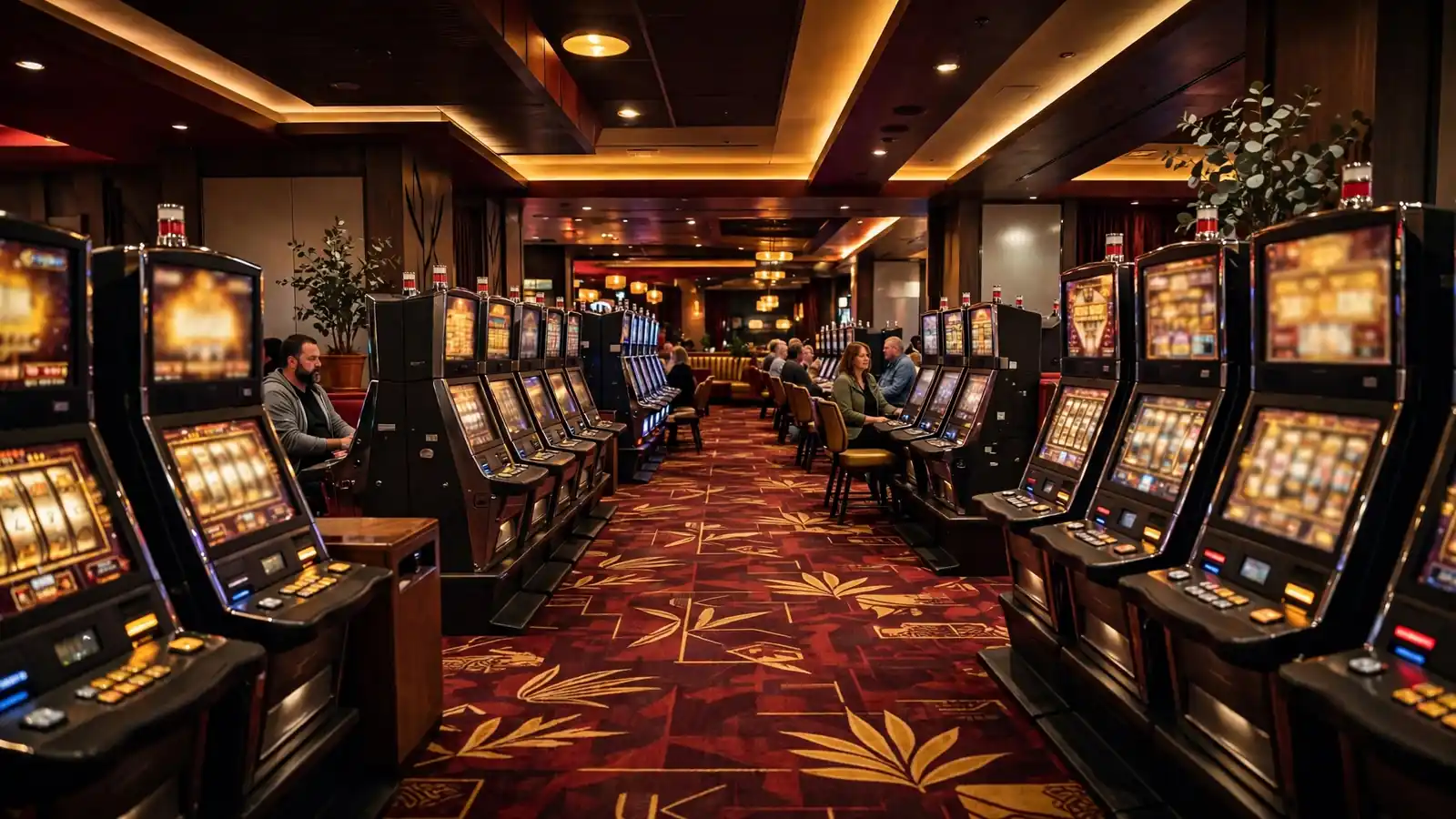
In Australia, “pokies parlour” is best understood as an informal description of a place associated with casino gaming machines. It is not, by itself, the name of a standard venue category or a reliable description of how a particular casino is arranged. A casino may have gaming machines as part of a much broader operation, while the word “parlour” can simply suggest a dedicated gaming area. The label alone tells you little about the venue’s layout, facilities or status.
That distinction matters when you encounter a business or website using similar wording. A familiar-sounding name does not establish that the service is a physical Australian casino, or that an online service has any Australian authorisation. The phrase belongs in the context of the country’s physical casino sector unless there is clear, independently verifiable information pointing elsewhere. A name is not a licence.
Australia’s casino industry operates under state and territory oversight. Each casino property holds a licence issued by the jurisdiction where it operates. This means the relevant regulatory connection is local to the physical property, rather than supplied by a generic national “parlour” label. If you are trying to understand what a particular venue is, the useful distinction is between the descriptive term and the property’s actual identity and jurisdiction.
If you’re looking for a pokies parlour casino in Australia in 2026, checking the available licensing and deposit details can help you assess each option. Use this list as a starting point and review the terms that matter to you.
Uptown Pokies
Uptown Pokies has operated since 2017 under a Curacao license, and its stated minimum deposit is A$20. These details give you a basic picture of its operating history and entry point.
Vegaz Casino
Vegaz Casino lists Curacao license OGL/2024/1335/0780 and a minimum deposit of EUR 20. You can use these details to check its licensing and deposit requirements.
Roby Casino
Roby Casino is listed as licensed by Curacao eGaming under Roby Games Ltd. You have no minimum-deposit amount specified here.
Lucky Dreams
Lucky Dreams lists a Curacao license and a minimum deposit of A$20 via POLi. You can factor in the stated payment method when considering it.
Thor Casino
Thor Casino lists a Curacao license held through Antillephone N.V. for Versus Odds B.V., and a minimum deposit of EUR 20. You can use these details as a starting point for checking its terms.
LevelUp Casino
LevelUp Casino lists Curacao eGaming license OGL/2023/174/0082 under Dama N.V. and a minimum deposit of A$15. You can check these details against the casino’s current terms.
SpinsUp
SpinsUp lists a Curacao Gaming Control Board license, OGL/2023/174/0082, under Dama N.V. You can use the stated licensing information as a reference when assessing it.
DragonSlots Casino
DragonSlots Casino lists a Curacao Gaming Authority license under Jumpman Gaming Ltd. You have no deposit details specified here.
Rollero Casino
Rollero Casino lists Curacao Gaming Control Board license OGL/2023/176/0095 under Hollycorn N.V. You can check this licensing information when researching the casino.
GoldenCrown
GoldenCrown lists Curacao Gaming Control Board license OGL/2023/176/0095 under Hollycorn N.V. You can use the stated license details as a reference when considering it.
A specialist review describes Australia as having more than 20 full-scale casinos across all eight states. That figure gives a sense of the sector’s breadth, but it should be read as an attributed description rather than a permanent classification. Venue counts and the way sources define a “full-scale casino” can change. The more durable point is that casino properties are distributed across the country and sit within separate state and territory licensing systems.
The gaming-machine total offers another way to understand the scale. Across Australian casinos, 3,308 machines are endorsed on venue licences and installed. This is a count of machines in casino venues, not a count of every gambling machine in Australia, and not a measure of how many are available at any one time. It also does not say that every casino has the same number or that each licensed machine is in use.
Those distinctions keep the figure useful. If you see a claim about a “pokies parlour” with no venue identified, the national total cannot tell you whether that claim refers to a licensed casino property, a particular gaming area or something using the phrase as branding. The machine count describes the sector in aggregate; it does not validate a specific name.
In ordinary Australian usage, “pokies” refers to gaming machines. Adding “parlour” gives the phrase a venue-like feel, but it does not make it a formal licence category. Likewise, “casino” may be used in a business name or promotional description without proving that the entity is one of the physical casino properties regulated by a state or territory. Treat the wording as a starting point for identification, not as evidence.
For a physical venue, the meaningful questions are concrete: which property is being discussed, where is it located, and which jurisdiction issued its casino licence? Those details connect a broad label to an accountable venue. They also prevent a common category error: assuming that a phrase associated with casino machines necessarily describes a standalone parlour or a specific style of operation.
For an online service, the same phrase should not be read as proof of local licensing. A website can borrow familiar Australian terminology, but a name and a physical-sector comparison do not establish its legal status. Online access and regulatory status are separate questions, and a casino-sounding label answers neither one. The terminology is suggestive; the evidence has to be specific.
So, when you see “pokies parlour” in an Australian casino context, read it as a loose reference to gaming-machine activity or a gaming area unless the named property supplies more precise details. Australia has a substantial physical casino sector, with thousands of licensed machines installed in casino venues, but the label itself does not identify a particular venue or confer any status. The distinction is simple. The name is not the venue.
A sign-up bonus or no-deposit offer can sound like a routine casino promotion. In Australia, that wording needs a different first check: is it promoting a service that may legally be provided to people here? The Interactive Gambling Act 2001 prohibits operators from providing real-money online casino games, including slots, poker and table games, to people physically located in Australia. Advertising those prohibited services to Australian audiences is also banned. A generous-sounding offer does not change that position.
The Australian Communications and Media Authority (ACMA) is the federal regulator responsible for enforcing the Act and monitoring compliance with federal interactive-gambling law. It can investigate operators that provide or advertise prohibited services. It can also ask Australian internet service providers to block access to websites that provide those services or advertise them in Australia.
That makes the central question more important than the size or wording of a promotion. A “no deposit” label does not establish that an online casino is lawful to offer here, and a sign-up bonus does not create an exception to the law. Nor does calling an offer a welcome reward, free credit or a trial alter the nature of the service if it is tied to prohibited real-money online casino gambling.
ACMA reports that, following enforcement action, it has blocked more than 1,455 illegal gambling and affiliate websites since November 2019. This figure concerns websites blocked; it is not a count of bonus campaigns, individual users or casino venues. The regulator’s blocking power is directed at access to sites associated with prohibited services or their advertising.
These numbers describe regulatory activity, not a ranking of offers or a measure of how attractive a promotion might appear. A large block count does not tell you whether a particular claim is genuine, and a withdrawal count does not show that every service using a bonus phrase has been assessed. Read them as context for enforcement, not as a shortcut to deciding an offer’s status.
When a page promotes a pokies parlour sign-up bonus, separate the marketing language from the legal question. First identify what is being promoted: a physical casino visit, or an online account for casino-style games. Then consider whether the promotion is inviting people in Australia to use real-money online casino services. If so, the promotion concerns a service that operators cannot lawfully provide here, regardless of whether the account appears to open or the offer is described as free.
Keep the claims in separate columns:
| Claim on the page | What it establishes |
|---|---|
| “No deposit” or “sign-up bonus” | That the page uses promotional language |
| A stated reward or welcome offer | What the advertiser says it is offering |
| ACMA enforcement powers | That the regulator can investigate and request website blocking |
The first two rows do not establish that the service is lawful. The third describes regulatory authority; it does not certify a particular operator or promotion. That distinction matters because bonus copy is designed to draw attention to an apparent benefit, while the legality of the underlying service is a separate issue.
A claim may also be framed indirectly, through an affiliate page or another promotional route. ACMA’s blocking authority covers websites providing prohibited interactive gambling services or advertising them in Australia. The presence of promotional wording on a separate page does not, by itself, make the underlying service acceptable. The relevant issue remains the service being promoted and whether it falls within the prohibition.
For a reader, the most useful comparison is therefore not between two headline rewards. Compare what each page actually describes, whether it points to online casino gambling, and whether the promotion depends on a service prohibited in Australia. Avoid treating a bonus label as evidence of regulatory approval; ACMA’s role is enforcement, not endorsement.
Legal Prohibition
The Interactive Gambling Act 2001 prohibits operators from providing real-money online casino games to people physically located in Australia, and advertising such services is also banned.
The same caution applies to “no deposit” wording. It describes how an advertiser presents an offer, not an exemption from the Interactive Gambling Act. No promotional phrase can override the law. The regulator’s powers are concrete; the headline is not.
A casino-style website can load on your device, display account pages or accept account traffic without being authorised to provide online casino games in Australia. Those are technical observations, not evidence of a local licence. The same applies if a familiar service appears at a different web address: a changed domain does not establish that the operator has become lawful or locally licensed.
The distinction matters because the Interactive Gambling Act 2001 prohibits operators from providing real-money online casino games to people in Australia. A site’s own claims, branding or account process do not override that rule. Nor does a page that opens provide a reliable test of its regulatory status. Access can tell you that a page is reachable at that moment; it cannot tell you that the service is permitted.
Reachable is not authorised.
Website blocking can affect whether particular domains resolve through Australian internet service providers. As a result, an address that worked at one time may later be inaccessible, while an alternate address may appear. A specialist review describes this changing-address pattern and notes that blocking can affect domain access over time. Neither outcome proves anything about Australian licensing: a blocked address is not a licence decision you can interpret in isolation, and a newly visible address is not approval.
The Australian Communications and Media Authority (ACMA) enforces the Interactive Gambling Act and can ask Australian internet service providers to block websites providing prohibited interactive gambling services or advertising them in Australia. ACMA has taken blocking action against illegal gambling services, including alternate domains associated with Fair Go, as recorded in a specialist review. Blocking is one part of enforcement; it does not turn a domain’s availability into a legal status indicator.
ACMA Enforcement
The Australian Communications and Media Authority (ACMA) can request that internet service providers block access to websites that provide prohibited interactive gambling services or advertise them in Australia.
This is why checking the address alone is a weak way to assess a site. Operators can use more than one domain, and the technical route to a page can change. The page may load from one connection and fail from another, or it may be replaced by a new address. None of those outcomes confirms that the service is permitted to offer online casino games to people in Australia.
Separate what you can observe from what those observations mean:
| Observation | What it establishes | What it does not establish |
|---|---|---|
| A page loads | The address is reachable for you at that time | Australian licensing or permission to provide casino games |
| An account page accepts traffic | The site is processing that traffic | That the service is lawful in Australia |
| A different domain appears | The operator or site is using another address | That the new address has regulatory approval |
| A domain does not resolve | Access to that address is unavailable through your connection | The complete regulatory status of the operator |
For a site presenting itself as a place to play online, treat claims of local approval as claims that need credible confirmation, not as facts demonstrated by a working page. The relevant question is not simply whether you can open it, but whether the service is allowed to offer those games to people in Australia. Under the federal law, operators cannot provide real-money online casino games to people physically located here.
If the address changes, reassess the claim rather than assuming the replacement is a legitimate continuation. A fresh domain does not reset the legal position. And if a site is blocked, trying another address would not make the service authorised. The reliable conclusion from access alone is narrow: the page was, or was not, reachable through your connection at that time.
A promise of complimentary chips or spins is not proof that a usable offer exists for you in Australia. The wording may describe a promotion in general, repeat an old claim, or point to an online casino service that is not available as a lawful real-money casino service here. Treat the phrase as an unverified claim, not an invitation to create an account or deposit money.
The distinction is practical. A genuine offer would need to identify who is making it, where it applies and what conditions govern it. Without those details, you cannot tell whether it is current, whether Australian residents are included, or whether the advertised benefit is actually obtainable. A bright banner is not a substitute for terms.
Before relying on any statement about free chips or spins, look for clear, consistent information:
If these details are absent or conflict with one another, the sensible comparison is simple: an unsupported claim ranks below one that can be checked. That does not establish that any offer is available; it only gives you a way to judge the quality of the information.
Be cautious with wording that makes a benefit sound automatic. “Free” can describe an advertisement without establishing who qualifies, what must happen first, or whether the offer applies to people in Australia. Those are not minor distinctions. They determine whether the claim has any practical meaning for you.
A search for complimentary casino chips may reflect interest in a physical venue, while a free-spin claim often appears in material about online casino play. The words alone do not settle which setting is meant. Check the context rather than assuming that a venue’s name, imagery or Australian references make an online offer a local casino promotion.
For an in-person venue, rely on information tied to that venue and its own access arrangements. For an online claim, do not treat a welcome message or promotional page as evidence that real-money casino play is permitted in Australia. A free introductory benefit does not change the nature of the service being offered.
No dependable decision follows from the word “free” by itself. If the provider, setting and conditions cannot be established, set the claim aside rather than treating it as cash value or a reason to proceed. That is a more useful conclusion than guessing at terms that have not been clearly stated.
A useful review gives you something firmer than a star rating to assess. Start with the venue it actually describes: does the review identify a particular casino, or does it use broad language that could apply to almost any gaming venue? Without a clear venue, claims about service, atmosphere or facilities are difficult to connect to a real place.
The next useful detail is jurisdiction. Australia’s casino industry is regulated by state and territory authorities, and each casino operates under a licence issued by its local jurisdiction. A review that names the relevant state or territory gives you a basis for checking whether its account concerns the right regulatory setting. A vague claim that a venue is “licensed in Australia” is less informative: it leaves out the local authority that matters.
Read each claim according to what kind of claim it is. Statements about a venue’s identity or jurisdiction can, in principle, be checked against authoritative information. Descriptions such as “welcoming”, “high-end” or “the best parlour” are judgments. They may reflect the reviewer’s priorities, but they do not establish a venue’s licence or prove that another visitor would share the same view.
A simple comparison table can keep those categories apart:
| Review detail | What it helps you assess |
|---|---|
| Named venue | Whether the review concerns a specific place |
| State or territory | Which local jurisdiction is relevant |
| Licence information | Whether the review identifies the venue’s local licensing context |
| Personal impressions | The reviewer’s preferences, not a regulatory finding |
The table is not a scoring system. It is a way to avoid treating every sentence as equally reliable. If a review supplies an enthusiastic verdict but no identifiable venue or jurisdiction, the verdict has little factual support. If it names both, you have a clearer starting point, though the review’s opinions remain opinions.
Also notice whether the language is precise. “This casino holds a licence issued by its local jurisdiction” is a claim with a defined subject. “Fully approved” or “officially the safest” sounds decisive but does not say who issued an approval, what it covers or how the ranking was reached. A confident tone cannot fill those gaps. Neat packaging, thin evidence.
When two reviews disagree, compare what each one values before deciding which is more useful to you. One may focus on ambience; another may give more attention to service. Neither preference automatically makes its overall rating a better guide. The useful review is the one whose stated criteria match what you want to evaluate—and whose factual details are clear enough to verify.
Be cautious with a rating presented without an explanation of how it was reached. A number on its own does not show whether the reviewer assessed the venue, relied on another description or simply expressed a preference. Look for a reasoned link between the evidence and the verdict. If that link is absent, treat the rating as an opinion, not a finding.
For a pokies parlour casino review, the strongest starting point is therefore modest: identify the venue, identify its state or territory, and look for a clear reference to its local licence. Then weigh the reviewer’s descriptions against the criteria that matter to you. That approach will not tell you what you must prefer. It will tell you what the review actually supports.
Australia’s gambling map is easier to read when you separate two measures: cities where gambling facilities are listed, and the locations of casinos themselves. They are not interchangeable counts. A city tally can include different kinds of gambling facilities, while a casino count refers to casino properties. Treating one as a substitute for the other makes the map look more precise than it is.
A specialist review gives a national count of 147 cities with gambling. That figure is best read as the review’s recorded coverage, not as a permanent official total: listings can change, and the category “gambling” is broader than casinos alone. It offers a sense of spread across the country, but does not tell you how many casinos are in each state or territory.
| Area | What a specialist review reports |
|---|---|
| Australia | 147 cities with gambling |
| Sydney, New South Wales | The country’s largest gambling city, with 11 gambling facilities |
| Northern Territory | 3 casinos across 3 cities |
| Alice Springs, Northern Territory | 1 casino; the city with the most casinos in the territory |
The Sydney figure is a count of gambling facilities, not a count of casinos. That distinction matters when comparing it with the Northern Territory figures, which are presented as casino counts. The review’s labels describe different units, so adding them together or treating them as equivalent would produce a misleading comparison.
The Northern Territory entry suggests a dispersed pattern: its reported casinos are spread across three cities rather than concentrated in one. Alice Springs is listed as having one casino and as the territory’s city with the most casinos. Read those statements alongside the reported territory-wide total, rather than as evidence that the city holds a large share of the country’s casino market. One casino is still one casino.
At the state-and-territory level, Australia’s casino industry is regulated by the jurisdiction where each property operates. That local framework is a more useful starting point for checking a specific casino than a broad national city count. A location tally can help you identify where facilities are recorded; it does not establish the details of a property’s licence or provide a complete directory.
For a practical comparison, use the same measure on each line: city, casino, or all gambling facilities. Then compare like with like. The specialist-review figures above give a useful snapshot of geographic concentration, but they should not be mistaken for a live register. Counts change. Labels matter.
A bonus label is a description, not proof that a promotion exists. A page referring to a pokies parlour bonus may be using familiar wording, repeating an old claim or describing something that applies to a different venue or service. The phrase alone tells you none of those details.
Separate three questions: what is being offered, who is offering it, and whether it is appropriate to promote to people in Australia. If the page does not clearly identify the offer and its provider, there is no sound basis for treating it as available. If the wording is vague, an attractive headline does not fill the gap.
| Check | What it can establish |
|---|---|
| Named provider | Which venue or service the claim concerns |
| Clear offer details | What the promotion says it includes and who it applies to |
| Australian context | Whether the claim is presented for people in Australia |
A missing answer is not a small detail. It changes what the claim means. A promotion associated with a physical casino, for instance, should not be assumed to describe an online service; equally, a page using casino language does not establish that a local venue is running an offer.
There is also a separate advertising question. In Australia, real-money online casino games are prohibited for operators to provide to people located here, and advertising those services to Australian audiences is not allowed. So a bonus claim cannot be treated as suitable to promote merely because it is visible on a webpage or uses local-sounding wording. The label does not make the underlying service acceptable.
For a “pokie parlour” offer, the useful distinction is between a verifiable statement and a promotional suggestion. A specific, attributable claim can be assessed on its stated terms. A generic reference to a bonus cannot establish availability, eligibility or suitability for Australian advertising. Those are different standards; passing one would not automatically pass the others.
The practical reading is restrained: treat the wording as unconfirmed unless the provider and the relevant terms are clear, and do not present it as an available Australian promotion on the strength of the label alone. That avoids turning an ambiguous phrase into a promise. No promise, no confusion.
A VIP parlour is not a standard feature you can assume every Australian casino offers. The phrase may describe a restricted area within a venue, but it does not tell you whether access is available to all visitors, requires membership, or is not offered at that property. Treat “VIP” as an access label to verify, not as a synonym for ordinary casino entry.
The clearest nationwide entry rule is age: you must be at least 18 to enter a casino. Meeting that minimum does not, by itself, grant access to a members-only casino or to a restricted area within a venue. Those are separate conditions. A venue can admit eligible visitors to its general casino areas while reserving another space for members; the reverse should not be assumed either.
When comparing access, separate three questions: whether the venue admits general visitors, whether a particular area is members-only, and what conditions apply to that membership. A claim about a VIP parlour answers none of these unless it identifies the venue and explains the access arrangement. A polished label is not an entry policy.
For a useful comparison, record the exact access category and the evidence supporting it. “Casino entry from age 18” is a general threshold; “members-only” describes a restriction on who may enter a particular venue or area. They are not interchangeable. If the wording does not say which applies, the access status remains unclear.
That distinction matters more than the label. First establish whether you can enter the venue; then check whether the area you have in mind has separate membership conditions. No universal VIP rule follows from the national age requirement.
A venue name is only a starting point when you are trying to identify a physical casino. The useful details are the address and locality attached to it: they help distinguish a real-world destination from a page that merely uses familiar casino language. Treat “parlour” as a description in a search, not as proof that a venue has that formal name or a separate status.
For Lasseters Casino, the listed location is 93 Barrett Drive in Alice Springs, Northern Territory, with the postcode 0870 and Australia as the country. That is the kind of entry you can compare against a venue’s own location information before planning a visit. Keep the full address together; the suburb or city alone may not identify the precise destination.
The Country Club Casino listing points to Country Club Avenue, in Prospect, within Meander Valley. Here, the locality information matters as much as the venue name: it places the address in a particular area rather than leaving “Country Club” to carry the identification by itself. The street name is written in full here, rather than as the abbreviated form commonly used in an address line.
These examples show why a useful venue record should connect the casino name to a street location and a recognisable locality. When details differ between listings, compare the venue name and the location fields rather than assuming that a similar label refers to the same place. For planning, use the address as a locator, not as a claim about facilities, access arrangements or current opening conditions.
Specific beats vague. The criterion is clear: a named venue should be traceable to a concrete place. That is what makes a physical listing more useful than a generic reference to pokies.
“Real-money casino” can describe two very different settings. In Australia, it may refer to gambling at a physical casino, or it may lead you to a website presenting casino-style games. Those are not interchangeable forms of access.
The physical-venue picture has a concrete measure: Australian casino licences endorse a total of 3,308 gaming machines installed across casinos. That figure describes equipment at licensed venues; it does not describe online play, the number of sites available, or a guarantee that a particular machine or venue is open to you. If you are comparing physical options, the relevant details are the venue itself and the rules applying there.
Online casino-style games involving real money sit in a different legal category. The Interactive Gambling Act 2001 prohibits operators from providing services such as online casino games to people physically in Australia. A website’s presentation, including language that makes it look like a local parlour, does not turn online play into gambling at a licensed physical venue.
Keep the distinction clear before acting on any result. A physical casino is a place with a local venue and a state or territory licence. An online service is not a physical parlour, even if it uses similar wording or imagery. The number of machines installed in Australian casinos cannot be used to validate an online offer or describe its legal status.
For a real-money casino experience in Australia, the meaningful comparison is therefore physical venue against physical venue—not a casino floor against a website. That is a different category, not a different entrance.