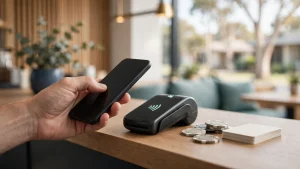
The guide explains how operator checks and payment routes shape the wait between requesting a withdrawal and receiving funds.

A “same-day” payout claim can describe only part of the time between submitting a withdrawal request and receiving funds. The key distinction is between the operator’s decision to release the money and the payment service’s transfer after release. An instant payment does not make the entire journey instant: a request may still be waiting for checks or approval before the transfer can begin.
That distinction matters in Australia, where providing real-money online casino games to people physically located in the country is prohibited under the Interactive Gambling Act 2001. The timing language below describes how payout claims are structured; it is not an offer or recommendation to use an online casino.
The first stage is internal. The operator receives the request, checks whether it can be approved and may ask for information before releasing the funds. The second stage starts when the payment is sent. Its speed depends on the payment route and on the relevant processing window.
If you’re looking for a same-day payout casino in Australia, treat this list as a starting point rather than a guarantee of payout timing. Check the casino’s current withdrawal terms and available payment methods before you deposit.
Uptown Pokies
It has operated since 2017 under a Curacao licence, and its minimum deposit is A$20. The available details do not establish whether payouts are completed the same day.
Vegaz Casino
It holds Curacao licence OGL/2024/1335/0780 and has a minimum deposit of EUR 20. No payout timing is specified in the available details.
Roby Casino
It is listed as holding a Curacao eGaming licence through Roby Games Ltd. The available details do not specify a minimum deposit or payout timing.
Lucky Dreams
It has a Curacao licence and a minimum deposit of A$20 via POLi. The available details do not confirm same-day withdrawals.
Thor Casino
It is licensed in Curacao by Antillephone N.V. for Versus Odds B.V., with a minimum deposit of EUR 20. No payout timing is provided.
LevelUp Casino
It is listed under Curacao eGaming licence OGL/2023/174/0082, held by Dama N.V., and has a minimum deposit of A$15. The available details do not state how quickly withdrawals are processed.
SpinsUp
It is listed under Curacao Gaming Control Board licence OGL/2023/174/0082, held by Dama N.V. The available details do not specify its minimum deposit or payout timing.
DragonSlots Casino
It is listed as licensed by the Curacao Gaming Authority through Jumpman Gaming Ltd. The available details do not provide a minimum deposit or information about payout speed.
Rollero Casino
It is listed under Curacao Gaming Control Board licence OGL/2023/176/0095, held by Hollycorn N.V. No minimum deposit or payout timing is specified in the available details.
GoldenCrown
It is listed under Curacao Gaming Control Board licence OGL/2023/176/0095, held by Hollycorn N.V. The available details do not state its minimum deposit or withdrawal speed.
A claim about a quick transfer therefore does not establish how long the request will take from submission to approval. If the operator has not released the funds, the payment network has nothing to transfer. The clock that matters to you starts when you submit the request, but an advertised “instant” payment may refer only to what happens after approval.
A specialist review reported instances in which sites describing withdrawals as “instant” took as long as 24 hours because of internal review. That is a reported example, not a timetable that applies to every operator. It does, however, show why the word “instant” needs a clear definition: it might describe the transfer after release, not the full interval from request to receipt.
A first withdrawal can bring identity checks into the process. Casino operators must verify a player’s identity before processing withdrawals, and first-time requests often trigger a request for verification. If documents or account details still need review, approval can wait even if the payment method can move funds rapidly once the operator releases them.
A specialist review has also noted first-withdrawal verification as a common reason for a delay. Completing identity checks before requesting a withdrawal can help prevent that step from starting only when you are waiting for a payout. It does not remove the operator’s responsibility to verify identity or guarantee a particular approval time.
Details matter, too. A mismatch between the withdrawal information and the account details can prompt further review. For PayID, the same details used for a deposit should be used for a withdrawal; funds should go only to an account linked to the casino profile. These checks concern whether a request can be released, not how quickly a transfer moves afterwards.
Approval may not be followed by an immediate transfer if the operator or payment service processes requests within set windows. A request can be approved but remain pending dispatch until the relevant processing period. After dispatch, the receiving bank or payment service may have its own handling time. These are separate points in the timeline, even if an operator’s wording groups them under one payout estimate.
This is why “same day” is not a complete description by itself. You need to know whether the stated timing begins when you submit a request, when it is approved, or when the funds are sent. If those starting points are unclear, the claim does not tell you how long the full process may take.
The payment route is another part of the calculation, but it cannot override a pending review. A transfer route that supports rapid movement can shorten the payment stage; it cannot make an unapproved request move. Conversely, a request released promptly may still take longer to arrive if the receiving route has a slower processing window.
To interpret a same-day payout claim, separate the events: request submitted, identity and account checks completed, withdrawal approved, funds dispatched, and money received. Each stage can affect the total elapsed time. A claim that refers only to dispatch or transfer speed should not be read as a promise about the entire sequence.
Attention: An advertised "instant" payment may refer only to the transfer after approval, not the full interval from your request to receipt.
The practical test is simple: identify what “same day” measures and where the operator’s approval stage ends. If the wording treats a fast payment as though it guarantees immediate receipt from the moment of request, it blurs two different processes. “Instant” needs a boundary.
For a withdrawal, the payment route affects how long funds may take to reach you after they have been released. It does not make every part of the transaction same-day: a casino’s handling and the payment provider’s transfer are separate steps. Comparing methods is useful for understanding that distinction, not as a recommendation to use real-money casino services.
That distinction matters in Australia. The Interactive Gambling Act 2001 prohibits operators from providing real-money online casino games, including slots and table games, to people in the country. The comparison below is informational; it is not an invitation to use an offshore service.
| Method | Timing described in available material | What the comparison tells you |
|---|---|---|
| E-wallets, including PayPal and Skrill | Withdrawals are typically processed within 24 hours | The quoted timeframe concerns processing, not a guaranteed arrival time |
| Cards | Payments may take several days | A card withdrawal should not be assumed to arrive on the day it is requested |
| Bank transfer | A specialist review reported that a traditional transfer can take as long as five business days | The estimate is source-specific, not a fixed timetable for every transfer |
These are not interchangeable promises. “Processed” can refer to the point at which a payment is handled, while “received” means the funds have appeared in your account. A timeframe for one stage should not be read as a deadline for the whole route.
An e-wallet is a separate payment account used to move funds between a service and a user. PayPal and Skrill are examples named in specialist coverage of payment options available to Australian players. That coverage also describes bank transfers and credit and debit cards, while noting that some services may offer cryptocurrency. Availability depends on the operator and payment arrangements; a method mentioned in a review is not necessarily available everywhere.
For e-wallet withdrawals, the stated processing timeframe is within 24 hours. That gives you a useful comparison point against the longer periods associated with cards and bank transfers. It is still a processing estimate, not a promise that money will be in your wallet within that period. The particular service, account setup and transaction handling can matter, and the route’s label alone cannot establish the time of receipt.
An e-wallet may therefore look preferable if the criterion is the stated processing window. If your priority is a familiar route or one that connects directly with your existing banking arrangements, a shorter estimate may not settle the choice. “Faster” describes only one part of the comparison.
Stated processing window is within 24 hours; often viewed as a faster processing option.
Withdrawals may take several days; familiarity does not guarantee immediate transfer.
Traditional transfers can take as long as five business days according to specialist reviews.
Credit and debit cards appear among the payment options described for Australian players. Their familiarity can make them easy to recognise, but it does not make the withdrawal timeline immediate. Card payments may take several days, so a same-day withdrawal should not be inferred simply because the card was used for a deposit.
The card route also needs to be distinguished from card funding in general: a method being listed as an available payment option does not establish that it can receive a withdrawal in every case. Check the payment terms for the particular service to see whether the card can be used for cash-outs and what timing is stated. Do not assume that the time taken for one kind of card transaction applies to another.
That is the practical trade-off: cards may be familiar, while their stated withdrawal timing is measured in days rather than an immediate transfer. Familiarity is a convenience criterion, not a speed guarantee.
Bank transfers are another route described in specialist coverage. One specialist review puts the completion time for a traditional transfer at as long as five business days. Treat that as a reported upper timeframe, not a universal rule: payment services and circumstances can differ, and business days are not the same as calendar days.
The comparison with e-wallet processing is clear, but it should not be stretched into a guarantee about either method. An e-wallet’s stated processing window is within 24 hours; the specialist review’s bank-transfer estimate extends to five business days. These describe different sources and timing language, so they are best read as reference points rather than a controlled test.
If you are assessing a claim of same-day payment, look at which stage the stated timing describes and which method it covers. A short processing estimate for an e-wallet does not establish the arrival time for a bank transfer or card payment. Likewise, a bank-transfer estimate does not predict the timing of an e-wallet transaction.
A useful comparison asks three things: which withdrawal methods are actually available, what timeframe is stated for each, and whether that timeframe refers to processing or receipt. That is a comparison of reported timing, not a promise of same-day arrival.
The better option depends on your criterion: the stated processing window, familiarity, or the banking route you already use. No method name erases the difference between a request being handled and funds reaching an account. Small distinction. Big timetable.
PayID connects a bank account to an identifier, such as a phone number or email address, rather than requiring the sender to enter account details for each transfer. In Australia, it operates through the New Payments Platform (NPP), with Osko handling real-time payments between participating accounts. That describes the bank-transfer infrastructure; it does not mean every payment request is sent as soon as it is submitted.
PayID operates through the New Payments Platform (NPP) with Osko handling real-time payments between participating accounts.
For a withdrawal, the important distinction is between the operator’s decision to release funds and the transfer that follows. A specialist review has reported that funds can move instantly once an operator releases a PayID withdrawal. The near-real-time part therefore begins after approval. A request waiting for identity checks or other review has not yet reached the stage where the payment network can deliver it.
This is why a claim about an instant transfer does not establish that a request will travel from submission to receipt instantly. The bank network can process a released payment in real time, while the operator’s approval remains a separate step. The two stages have different causes of delay and should not be treated as one clock.
Where a PayID withdrawal process is offered, the request may involve opening the account’s wallet or withdrawal area, entering the PayID identifier, specifying the amount and confirming the transaction. The details matter: players must use the same PayID information used for deposits to avoid triggering a security review, and funds should go only to an account linked to the player profile. Identity must also be verified before a withdrawal is processed. A fast payment rail cannot replace those checks.
There is also an important Australian legal context. The Interactive Gambling Act 2001 prohibits operators from providing real-money online casino games, including slots and table games, to people in Australia. PayID’s availability as a bank service does not make such casino services lawful for operators to provide.
So, when you encounter a claim about same-day payment through PayID, separate the transfer mechanism from the operator’s handling of the request. Osko can move a released payment in real time; it cannot approve a pending withdrawal. Fast after release, not before.
A same-day payout claim can describe a target, a payment stage or a limited set of circumstances. It does not establish that every withdrawal request will reach your bank account on the day it is submitted. Before funds can move, an operator may need to check the account and approve the request; after release, the payment method and the receiving bank can affect when the money appears.
There is also an important Australian context: the Interactive Gambling Act 2001 prohibits operators from providing real-money online casino games, including slots and table games, to people physically located in Australia. A payout claim should not be read as an invitation or assurance that an offshore service is lawful or available to Australian residents.
Identity verification is a frequent point of friction on a first withdrawal. An operator may ask you to confirm who you are before approving a cash-out. If documents are incomplete, difficult to read or inconsistent with the account details, the request can remain under review while the operator seeks clarification. That review is separate from the time taken by a bank or payment provider to deliver released funds.
Completing identity verification before submitting a withdrawal can remove avoidable obstacles and make later requests more straightforward.
Completing verification before submitting a withdrawal can make later requests more straightforward. It does not guarantee same-day approval: an operator can still review a particular transaction or ask for further information. But resolving routine identity checks early removes one avoidable obstacle when you eventually request a payout. A promise about speed is less useful if the account is not ready to be checked.
A specialist review identifies first-time identity checks, larger withdrawals and bank processing windows among possible causes of delay. These are possible interruptions, not a timetable that applies to every operator. In particular, the review flags requests above $2,000 as a point where additional scrutiny may arise. That does not mean every larger request will be delayed by the same amount of time, or that a smaller one will be approved automatically.
For withdrawals above $2,000, operators must disclose any manual review process. Check the relevant terms for how requests are handled, rather than assuming that a same-day headline applies regardless of amount. A manual check may involve extra scrutiny before release; it is not the same thing as a slow bank transfer. Different stages, different causes.
Approval and receipt are not the same event. Once an operator releases a payment, the receiving institution and its processing window may determine when the funds become available. A request approved on the same calendar day can therefore reach your account later, particularly where the chosen route does not settle continuously or where banking schedules intervene.
The phrase “same day” can also leave the starting point unclear. It may refer to the time between approval and release, rather than the full period from submitting a request to seeing cleared funds. Look for wording that distinguishes those stages. If a claim does not say when its clock starts or ends, it is difficult to compare with another claim.
Payment details can create another pause. Operators generally seek to return funds to the deposit method where possible. If the withdrawal details do not match the account or method used to fund it, the operator may need to check the request or ask you to select an eligible route. Use payment details linked to your account, and keep them consistent with the details used for deposits where the service permits that route. A correction can add handling time before a payment is released.
When an operator advertises a same-day payout, look for the conditions that sit behind the phrase: whether the account must already be verified, whether requests can receive manual review, and whether processing depends on the time the request is submitted. Then separate the operator’s approval time from the delivery time stated for the payment method. Those details are more informative than a short promotional label.
A payout can miss the same-day window even when the request is genuine and the account holder has done nothing wrong. Verification, transaction review and bank schedules can each affect a different part of the process. Treating “same day” as a guaranteed arrival time collapses those separate steps into one promise. That is too neat.
Legal Prohibition
The Interactive Gambling Act 2001 prohibits operators from providing real-money online casino games to people physically located in Australia.
The amount shown in an account balance is not always the amount available to withdraw. Bonus rules, cash-out caps and transaction charges can each change what you receive or whether a withdrawal request is ready to submit. Read those terms separately: a clear payment route does not override conditions attached to the funds.
There is an important Australian context. The Interactive Gambling Act 2001 prohibits operators from providing real-money online casino games to people in Australia.
Before submitting a request, check whether any bonus attached to the account has wagering requirements. The rules can apply to bonus funds alone or to the combined value of the deposit and bonus. A specialist review has described bonus-only wagering as the preferable structure, because the deposit is not swept into the same calculation. The exact effect depends on the terms attached to the offer.
Look for the definition of “wagering contribution” as well as the requirement itself. Terms may explain which games count toward progress and whether some play contributes less than other play. If the rules say the bonus balance remains restricted until the requirement is met, a cash-out request may be unavailable or may cancel the bonus. If the deposit and bonus are treated together, withdrawing early may also affect the deposit balance. Read the withdrawal and bonus clauses as a pair, not as separate promises.
Check whether accepting a bonus is optional and whether the account has an active offer. A balance can include funds with different withdrawal conditions, so the total displayed is not necessarily a reliable guide to what can be cashed out. The relevant figure is the amount the terms classify as eligible for withdrawal after applicable requirements have been satisfied.
A casino’s policy may restrict withdrawal amounts. A per-transaction maximum is only one part of the picture: a specialist review has also noted that weekly or monthly cash-out caps may sit alongside it. That distinction matters if you plan to withdraw a balance in stages. Several requests can still fall under a separate period limit.
Check the minimum and maximum for each request, any cap over a stated period, and whether the limit changes by payment method or account status. Look for rules on instalments, too. Large withdrawals may be released in parts under an operator’s policy, which can affect how much arrives in a single transaction even when the full balance is eligible.
The terms should make clear which limit applies to your situation and how it is calculated. A cap may concern the amount requested, the amount paid after charges, or the total released during a period. If the wording does not distinguish those measures, ask for clarification before relying on a displayed balance. A headline maximum without its period or calculation method is not a complete limit.
A payment route may carry a transaction charge. In a report published by filmink.com.au, a fee is identified as a possible cost when PayID is used for a withdrawal. That does not establish that every PayID transaction is charged; the applicable terms need to state whether a fee applies and how it is calculated.
Check whether a charge is deducted from the withdrawal, added separately, or imposed by another party involved in the transfer. Also look for currency conversion costs if the account balance and receiving account use different currencies. Do not assume that a fee-free deposit means a fee-free withdrawal. Compare the amount requested with the amount expected to reach the linked account, after any stated deductions.
Keep the payment details consistent with the account. The same PayID details used for a deposit should be used for a withdrawal, and funds should go only to an account linked to the casino profile. These conditions can be relevant to whether a request proceeds without a security review.
Before you submit, confirm that bonus requirements are complete, the requested amount fits both transaction and period limits, and any fee is understood. Then check that the selected destination is linked to the account and matches the payment details used where required. If the terms describe staged releases or a separate cap, calculate the request against those rules rather than relying on the balance screen.
A same-day cash-out claim does not change any of these conditions. “Ready to withdraw” is a question of eligibility under the account terms, not merely a button becoming available. Paperwork first.
A slots win does not create a separate route for cashing out. The withdrawal still has to pass through the service’s own process, then travel by the payment method attached to the request. The game category alone says nothing about when funds reach an account. “Same day” is therefore a claim about the full route only if it accounts for both stages; a quick payment method cannot make an unreleased withdrawal arrive.
There is also an important Australian context: under the Interactive Gambling Act 2001, operators are prohibited from providing real-money online casino games, including slots, to people in Australia.
Once a withdrawal has been approved, the chosen route becomes the main practical difference. E-wallet withdrawals are commonly described as being handled within a day, although that is not a guarantee for any individual transaction. Some specialist reviews have reported e-wallet transfers arriving within hours rather than days, but such reports can change with the service and circumstances. Bank transfers and card payments may take several days. So a slots balance does not make a slower payment route faster.
The useful comparison is not between one type of slot and another. It is between the payout route and the timing promised for it. If the service says an e-wallet payout is completed within a day, read that as a payment-stage estimate, not proof that a request submitted that day will also be approved and received that day. A bank or card route may add further time after release. Small print matters.
A slots-specific label describes the games, not the money movement. It does not establish that the service approves withdrawals instantly, that every payment method is equally quick, or that the recipient’s account will show funds as soon as a request is submitted. Those are separate parts of the process.
For any real-money service, the relevant terms should distinguish approval from transfer and state the available methods and their processing times. If those details are blurred together under “instant” or “same day,” the wording leaves out the point that matters: when the payment is actually released. A clear claim separates the internal handling from the time taken by the payment route.
That distinction also explains why two people can see different outcomes from what appears to be the same slots payout promise. Their requests may use different payment methods, and the published timing may refer only to one part of the journey. The game title is not the clock. The payment route is.
In Australia, the payment route does not change the legal status of the service: offering online casino games for real money to people in the country is prohibited under the Interactive Gambling Act 2001. The distinctions below describe how payment methods are reported to work, not a recommendation to use an offshore casino.
A specialist review has reported that some real-money casino services aimed at Australians have offered instant banking through providers such as POLi. “Instant” describes the banking function, not necessarily a completed cash-out: a payment can still depend on the operator releasing the funds, and the available route may differ between deposits and withdrawals.
Bank-linked options may feel familiar if you already manage money through an Australian account. Their practical value depends on whether the service supports the method for the transaction you want to make, and whether the account details match the account associated with your profile. A payment label alone does not establish that money can be withdrawn by that route.
E-wallets such as PayPal and Skrill are distinct from direct bank transfers because they use a separate payment account. Their presence in a cashier does not, by itself, confirm that the same wallet can receive a withdrawal; check the method’s stated role before relying on it.
Cryptocurrency is another route where offered. A specialist review has described crypto transactions as capable of being near-instant, but that wording concerns the transfer mechanism, not an operator’s review or approval. It also does not make the outcome equivalent to receiving funds in a bank account: the destination wallet and the casino’s own rules determine how the transaction is handled.
Prepaid cards and vouchers, including Neosurf, are described in a specialist review as deposit methods rather than withdrawal routes. That distinction matters: depositing with a voucher does not mean a cash-out can be sent back to it. You may need a different eligible destination for any withdrawal, subject to the service’s terms.
These are described in specialist reviews as deposit methods rather than withdrawal routes, meaning you may need a different destination for cash-outs.
The useful comparison is therefore not simply which method sounds fastest. Check whether a route supports withdrawals at all, what account or wallet can receive the funds, and whether the advertised speed applies only after release. A fast transfer cannot make an unavailable cash-out method usable.
Treat “same-day” as a claim to verify, not a promise that a withdrawal request will reach your account that day. Check whether the stated timing begins after the operator approves the request. A payment method can move funds quickly once released; it cannot remove the operator’s review beforehand.
Read the withdrawal terms for the minimum and maximum amounts, and look for any separate cash-out limits. A specialist review has reported that some Australian PayID offers describe auto-approval for withdrawals below $5,000 AUD. That is a reported claim, not a market-wide rule. Check the operator’s own terms to see whether auto-approval applies, what conditions qualify, and when a manual review can intervene.
Look especially for a clear explanation of manual checks on withdrawals exceeding $2,000. If the terms do not say when a request may be held for review, the same-day wording leaves an important part of the process unexplained. Published limits matter too: a maximum per transaction does not necessarily tell you whether other cash-out limits apply.
Before treating any payout claim as relevant to you, consider the Australian legal position. The Interactive Gambling Act 2001 prohibits operators from providing real-money online casino games, including slots and table games, to people in Australia. Offshore casino services are also actively blocked and enforced against. A payout claim is not evidence that a service is lawful or locally regulated.
A practical check is to compare the headline wording with the terms: approval conditions, review rules, withdrawal limits and the point at which the stated timing starts. If those details are absent or unclear, you cannot reliably assess what “same-day” means. Marketing is the easy part.
There is an important limit to this comparison in Australia: operators are prohibited from providing real-money online casino games to people in the country, and access to offshore services is actively blocked. So a promise of a same-day payout is not a reason to treat a real-money casino as a lawful local option.
If you are comparing payout claims as general information, start with the criterion that matters to you. For transfer speed, distinguish the payment method’s transfer time from the operator’s decision to release funds. An instant payment rail cannot make an unapproved withdrawal instant. A specialist review has reported that e-wallet transactions may be completed within hours rather than days; that is a report, not a guaranteed timeframe for every service.
Familiarity is a different criterion. A payment method you already understand may be easier to track than one that requires unfamiliar account details or a separate process. But familiarity does not establish that a service is available, lawful or suitable for your circumstances.
If withdrawal conditions matter most, read the terms before relying on a payout claim. The method is only one part of the decision: the account, operator’s review and applicable conditions can affect whether funds are released. A traditional bank transfer has been reported by a specialist review as taking as long as five business days. Treat that as a source-specific estimate, not a fixed rule.
There is no single “best” same-day payout option independent of these criteria. Speed favours a different comparison from familiarity, while clear and acceptable conditions may matter more than either. In Australia, however, the legal status comes first: comparing payout methods does not make prohibited online casino services lawful.
It varies by stage and payment route: PayID withdrawals may be near-instant once released, e-wallet withdrawals are typically processed within 24 hours, and card or traditional bank transfers can take several days. Identity checks, approval and processing windows can add time before the transfer begins.
Methods mentioned include PayID and other bank transfers, credit and debit cards, PayPal, Skrill and, at some sites, cryptocurrency. Prepaid vouchers such as Neosurf are generally for deposits, not withdrawals.
The cited payout comparison names Fastpay Casino, PlayAmo and National Casino, with reported average withdrawals of 47 seconds, 68 seconds and 3.2 minutes respectively. These figures describe reported payout performance, not a guarantee; providing real-money online casino games to people in Australia is prohibited under the Interactive Gambling Act 2001.
Check what the payout estimate measures, whether identity checks are complete, which payment methods support withdrawals, and whether limits and fees are clearly stated. Also check for auto-approval terms and whether withdrawals must return to the deposit method; fast payment processing cannot bypass a pending review.
The Interactive Gambling Act 2001 prohibits operators from providing real-money online casino games, including slots and table games, to people physically located in Australia.